Further iTextbook Thoughts

As happens frequently, for me, blogging about a topic makes me think even further about it. So I’m still thinking about learning content and what Apple’s announcement might have to do with it. However, I don’t really have time to write it as a “narrative” (gotta finish this ancillary material; plus, my brother-in-law just arrived in town). So I’ll post my notes as-is, to serve as a placeholder.

(Made easier by Brett Terpstra’s “Indented or Markdown to HTML Unordered List” Ruby script.)

  • Don’t call it content
    • Access to content
  • Allowing students to contribute content
  • Higher Ed
    • Less about backpack
    • Semi-autonomous learning
    • Self-learning
      • Autodidactic
  • Realities of markets
    • Sectors
      • Creation
      • Distribution
      • Consumtpion
  • But learning is different?
    • Material to make you think
  • Social media
  • Hopes for Moodle 2.0, Sakai 3
  • Lifelong learning
  • Apple-branded learning management system?
  • Not much hope for what it might represent
  • Gradebook
  • Beyond Numbers template
  • Portfolios
  • iWeb and beyond
  • Online/Offline
  • Flexibility
    • Updates
  • Index and search
  • Modular
  • Distraction-free learning
  • Minisites and encapsulation

Using WordPress as a Syllabus Database: Learning is Fun

(More screenshots in a previous post on this blog.)

Worked on a WordPress project all night, the night before last. Was able to put together a preliminary version of a syllabus database that I’ve been meaning to build for an academic association with which I’m working.

There are some remaining bugs to solve but, I must say, I’m rather pleased with the results so far. In fact, I’ve been able to solve the most obvious bugs rather quickly, last night.

More importantly, I’ve learnt a lot. And I think I can build a lot of things on top of that learning experience.

Part of the inspiration comes from Kyle Jones’s blogpost about a “staff directory”. In addition, Justin Tadlock has had a large (and positive) impact on my learning process, either through his WordPress-related blogposts about custom post types and his work on the Hybrid Theme (especially through the amazing support forums). Not to mention WordCamp Montrealofficial documentationplugin pagestutorials, and a lot of forum- and blogposts about diverse things surrounding WordPress (including CSS).

I got a lot of indirect help and I wouldn’t have been able to go very far in my project without that help. But, basically, it’s been a learning experience for me as an individual. I’m sure more skilled people would have been able to whip this up in no time.

Thing is, it’s been fun. Close to Csíkszentmihályi’s notion of “flow”. (Philippe’s a friend of mine who did research on flow and videogames. He’s the one who first introduced me to “flow”, in this sense.)

So, how did I achieve this? Well, through both plugins and theme files.

To create this database, I’ve originally been using three plugins from More Plugins: More Fields, More Taxonomies, and More Types. Had also done so in my previous attempt at a content database. At the time, these plugins helped me in several ways. But, with the current WordPress release (3.2.1), the current versions of these plugins (2.0.5.2, 1.0.1, and 1.1.1b1, respectively) are a bit buggy.

In fact, I ended up coding my custom taxonomies “from scratch”, after running into apparent problems with the More Taxonomies plugin. Eventually did the same thing with my “Syllabus” post type, replacing More Types. Wasn’t very difficult and it solved some rather tricky bugs.

Naïvely, I thought that the plugins’ export function would actually create that code, so I’d be able to put it in my own files and get rid of that plugin. But it’s not the case. Doh! Unfortunately, the support forums don’t seem so helpful either, with many questions left unanswered. So I wouldn’t really recommend these plugins apart from their pedagogical value.

The plugins were useful in helping me get around some “conceptual” issues, but it seems safer and more practical to code things from scratch, at least with taxonomies and custom post types. For “custom metaboxes”, I’m not sure I’ll have as easy a time replacing More Fields as I did replacing More Taxonomies and More Types. (More Fields helps create custom fields in the post editing interface.)

Besides the More Plugins, I’m only using two other plugins: Jonathan Christopher’s Attachments and the very versatile google doc embedder (gde) by Kevin Davis.

Attachments provides an easy way to attach files to a post and, importantly, its plugin page provides usable notes about implementation which greatly helped me in my learning process. I think I could code in some of that plugin’s functionality, now that I get a better idea of how WordPress attachments work. But it seems not to be too buggy so I’ll probably keep it.

As its name does not imply, gde can embed any file from a rather large array of file types: Adobe Reader (PDF), Microsoft Office (doc/docx, ppt/pptx/pps, xsl/xslx), and iWork Pages, along with multipage image files (tiff, Adobe Illustrator, Photoshop, SVG, EPS/PS…). The file format support comes from Google Docs Viewer (hence the plugin name).

In fact, I just realized that GDV supports zip and RAR archives. Had heard (from Gina Trapani) of that archive support in Gmail but didn’t realize it applied to GDV. Tried displaying a zip file through gde, last night, and it didn’t work. Posted something about this on the plugin’s forum and “k3davis” already fixed this, mentioning me in the 2.2 release notes.

Allowing the display of archives might be very useful, in this case. It’s fairly easily to get people to put files in a zip archive and upload it. In fact, several mail clients do all of this automatically, so there’s probably a way to get documents through emailed zip files and display the content along with the syllabus.

So, a cool plugin became cooler.

Syllabus Database (archive)

Download (syllabusdb-0.2.zip (ZIP, 4.61KB)

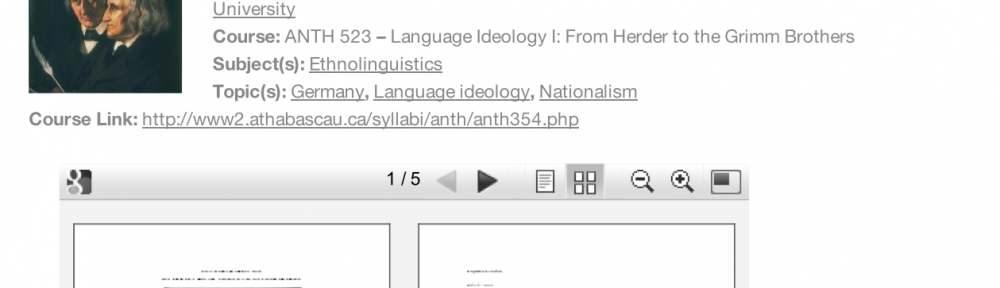
As it so happens, gde is already installed on the academic site for which I’m building this very same syllabus database. In that case, I’ve been using gde to embed PDF files (for instance, in this page providing web enhancements page for an article in the association’s journal). So I knew it could be useful in terms of displaying course outlines and such, within individual pages of the syllabus database.

What I wasn’t sure I could do is programmatically embed files added to a syllabus page. In other words, I knew I could display these files using some shortcode on appropriate files’ URLs (including those of attached files). What I wasn’t sure how to do (and had a hard time figuring out) is how to send these URLs from a field in the database: I knew how to manually enter the code, but I didn’t know how to automatically display the results of the code when a link is entered in the right place.

The reason this matters is that I would like “normal human beings” (i.e., noncoders and, mostly, nongeeks) to enter the relevant information for their syllabi. One of WordPress’s advantages is the fact that, despite its power, it’s very easy to get nongeeks to do neat things with it. I’d like the syllabus database to be this type of neat thing.

The Attachmentsplugin helps, but still isn’t completely ideal. It does allow for drag-and-drop upload and it does provide a minimalist interface for attaching uploaded files to blogposts.

First Attach Button (Screenshot)

Screenshot of First “Attach” Button

In the first case, it’s just a matter of clicking the Attach button and dropping a file in the appropriate field. In the second case, it’s a matter of clicking another Attachbutton.

Second Attach Button (Screenshot)

Screenshot of the Second “Attach” Button

The problem is between these two Attach buttons.

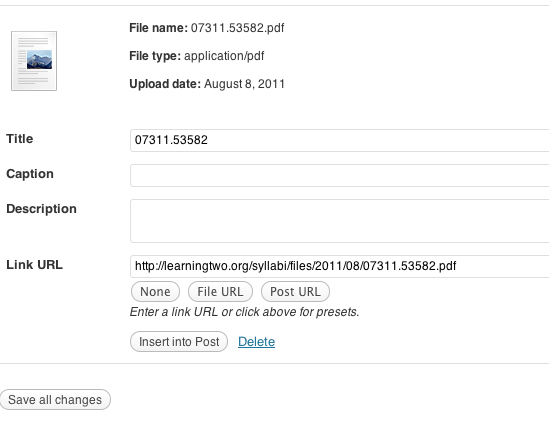
File Uploaded Screenshot

Screenshot of the Uploaded File

The part of the process between uploading the file and finding the Attach button takes several nonobvious  steps. After the file has been uploaded, the most obvious buttons are Insert into Post and Save all changes, neither of which sounds particularly useful in this context. But Save all changes is the one which should be clicked.

To get to the second Attach button, I first need to go to the Media Library a second time. Recently uploaded images are showing.

Images Only Screenshot

Screenshot of the Media Library Only Showing Images

For other types of files, I then click All Types, which shows a reverse chronological list of all recently uploaded files (older files can be found through the Search Media field). I then click on the Show link associated with a given file (most likely, the most recent upload, which is the first in the list).

Second Attach Button (Screenshot)

Screenshot of the second “Attach” Button

Then, finally, the final Attach button shows up.

Clicking it, the file is attached to the current post, which was the reason behind the whole process. Thanks to both gde and Attachments, that file is then displayed along with the rest of the syllabus entry.

It only takes a matter of seconds to minutes, to attach a file (depending on filesize, connection speed, etc.). Not that long. And the media library can be very useful in many ways. But I just imagine myself explaining the process to instructors and other people submitting syllabi for inclusion the the database.

Far from ideal.

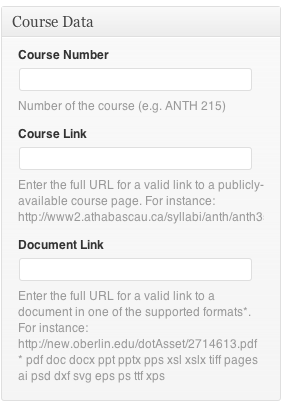
A much easier process is the one of adding files by pasting a file URL in a field. Which is exactly what I’ve added as a possibility for a syllabus’s main document (say, the PDF version of the syllabus).

Course Data Screenshot

Screenshot of the Course Data Box

Passing that URL to gde, I can automatically display the document in the document page, as I’m doing with attachments from the media library.  The problem with this, obviously, is that it requires a public URL for the document. The very same “media library” can be used to upload documents. In fact, copying the URL from an uploaded file is easier than finding the “Attach” button as explained previously. But it makes the upload a separate process on the main site. A process which can be taught fairly easily, but a process which isn’t immediately obvious.

I might make use of a DropBox account for just this kind of situation. It’s also a separate process, but it’s one which may be easier for some people.

In the end, I’ll have to see with users what makes the most sense for them.

In the past, I’ve used plugins like  Contact Form 7 (CF7), by Takayuki Miyoshi, and Fast Secure Contact Form (FSCF)  by Mike Challis to try and implement something similar. A major advantage is that they allow for submissions by users who aren’t logged in. This might be a dealmaking feature for either FSCF or CF7, as I don’t necessarily want to create accounts for everyone who might submit a syllabus. Had issues with user registration, in the past. Like attachments, onboarding remains an issue for a lot of people. Also, thanks to yet other plugins like Michael Simpson’s Contact Form to Database (CFDB), it should be possible to make form submissions into pending items in the syllabus database. I’ll be looking into this.

Another solution might be Gravity Forms. Unlike the plugins I’ve mentioned so far, it’s a commercial product. But it sounds like it might offer some rather neat features which may make syllabus submission a much more interesting process. However, it’s meant for a very different use case, which has more to do with “lead data management” and other business-focused usage. I could innovate through its use. But there might be more appropriate solutions.

As is often the case with WordPress, the “There’s a plugin for that” motto can lead to innovation.  Even documenting the process (by blogging it) can be a source of neat ideas.

A set of ideas I’ve had, for this syllabus database, came from looking into the Pods CMS Framework for WordPress. Had heard about Pods CMS through the WordCast Conversations podcast. For several reasons, it sent me on an idea spree and, for days, I was taking copious notes about what could be done. Not only about this syllabus database but about a full “learning object repository” built on top of WordPress. The reason I want to use WordPress is that, not only am I a “fanboi” of Automattic (the organization behind WordPress) but I readily plead guilty to using WordPress as a Golden Hammer. There are multiple ways to build a learning object repository. (Somehow, I’m convinced that some of my Web developing friends that Ruby on Rails is the ideal solution.) But I’ve got many of my more interesting ideas through looking into Pods CMS, a framework for WordPress and I don’t know the first thing about RoR.

Overall, Pods CMS sounds like a neat approach. Its pros and cons make it sound like an interesting alternative to WordPress’s custom post types for certain projects, as well as a significant shift from the main ways WordPress is used. During WordCamp Montreal, people I asked about it were wary of Pods. I eventually thought I would wait for version 2.0 to come out before investing significant effort in it.

In the meantime, what I’ve built is a useful base knowledge of how to use WordPress as a content database.

Can’t wait to finish adding features and fixing bugs, so I can release it to the academic organization. I’m sure they’ll enjoy it.

Even if they don’t ever use it, I’ve gained a lot of practical insight into how to do such things. It may be obvious to others but it does wonders to my satisfaction levels.

I’m truly in flow!

Espace social et innovation ouverte

Présentation pour le panel « Innovation ouverte et living labs, la divergence cohésive par les réseaux sociaux ?» organisé par Patrick Dubé dans le cadre de la dixième conférence internationale webcom Montréal.

Intimacy, Network Effect, Hype

Is “intimacy” a mere correlate of the network effect?

Can we use the network effect to explain what has been happening with Quora?

Is the Quora hype related to network effect?

I really don’t feel a need to justify my dislike of Quora. Oh, sure, I can explain it. At length. Even on Quora itself. And elsewhere. But I tend to sense some defensiveness on the part of Quora fans.

[Speaking of fans, I have blogposts on fanboism laying in my head, waiting to be hatched. Maybe this will be part of it.]

But the important point, to me, isn’t about whether or not I like Quora. It’s about what makes Quora so divisive. There are people who dislike it and there are some who defend it.

Originally, I was only hearing from contacts and friends who just looooved Quora. So I was having a “Ionesco moment”: why is it that seemingly “everyone” who uses it loves Quora when, to me, it represents such a move in the wrong direction? Is there something huge I’m missing? Or has that world gone crazy?

It was a surreal experience.

And while I’m all for surrealism, I get this strange feeling when I’m so unable to understand a situation. It’s partly a motivation for delving into the issue (I’m surely not the only ethnographer to get this). But it’s also unsettling.

And, for Quora at least, this phase seems to be over. I now think I have a good idea as to what makes for such a difference in people’s experiences with Quora.

It has to do with the network effect.

I’m sure some Quora fanbois will disagree, but it’s now such a clear picture in my mind that it gets me into the next phase. Which has little to do with Quora itself.

The “network effect” is the kind of notion which is so commonplace that few people bother explaining it outside of introductory courses (same thing with “group forming” in social psychology and sociology, or preferential marriage patterns in cultural anthropology). What someone might call (perhaps dismissively): “textbook stuff.”

I’m completely convinced that there’s a huge amount of research on the network effect, but I’m also guessing few people looking it up. And I’m accusing people, here. Ever since I first heard of it (in 1993, or so), I’ve rarely looked at explanations of it and I actually don’t care about the textbook version of the concept. And I won’t “look it up.” I’m more interested in diverse usage patterns related to the concept (I’m a linguistic anthropologist).

So, the version I first heard (at a time when the Internet was off most people’s radar) was something like: “in networked technology, you need critical mass for the tools to become truly useful. For instance, the telephone has no use if you’re the only one with one and it has only very limited use if you can only call a single person.” Simple to the point of being simplistic, but a useful reminder.

Over the years, I’ve heard and read diverse versions of that same concept, usually in more sophisticated form, but usually revolving around the same basic idea that there’s a positive effect associated with broader usage of some networked technology.

I’m sure specialists have explored every single implication of this core idea, but I’m not situating myself as a specialist of technological networks. I’m into social networks, which may or may not be associated with technology (however defined). There are social equivalents of the “network effect” and I know some people are passionate about those. But I find that it’s quite limiting to focus so exclusively on quantitative aspects of social networks. What’s so special about networks, in a social science perspective, isn’t scale. Social scientists are used to working with social groups at any scale and we’re quite aware of what might happen at different scales. But networks are fascinating because of different features they may have. We may gain a lot when we think of social networks as acephalous, boundless, fluid, nameless, indexical, and impactful. [I was actually lecturing about some of this in my "Intro to soci" course, yesterday...]

So, from my perspective, “network effect” is an interesting concept when talking about networked technology, in part because it relates to the social part of those networks (innovation happens mainly through technological adoption, not through mere “invention”). But it’s not really the kind of notion I’d visit regularly.

This case is somewhat different. I’m perceiving something rather obvious (and which is probably discussed extensively in research fields which have to do with networked technology) but which strikes me as missing from some discussions of social networking systems online. In a way, it’s so obvious that it’s kind of difficult to explain.

But what’s coming up in my mind has to do with a specific notion of “intimacy.” It’s actually something which has been on my mind for a while and it might still need to “bake” a bit longer before it can be shared properly. But, like other University of the Streets participants, I perceive the importance of sharing “half-baked thoughts.”

And, right now, I’m thinking of an anecdotal context which may get the point across.

Given my attendance policy, there are class meetings during which a rather large proportion of the class is missing. I tend to call this an “intimate setting,” though I’m aware that it may have different connotations to different people. From what I can observe, people in class get the point. The classroom setting is indeed changing significantly and it has to do with being more “intimate.”

Not that we’re necessarily closer to one another physically or intellectually. It needs not be a “bonding experience” for the situation to be interesting. And it doesn’t have much to do with “absolute numbers” (a classroom with 60 people is relatively intimate when the usual attendance is close to 100; a classroom with 30 people feels almost overwhelming when only 10 people were showing up previously). But there’s some interesting phenomenon going on when there are fewer people than usual, in a classroom.

Part of this phenomenon may relate to motivation. In some ways, one might expect that those who are attending at that point are the “most dedicated students” in the class. This might be a fairly reasonable assumption in the context of a snowstorm but it might not work so well in other contexts (say, when the incentive to “come to class” relates to extrinsic motivation). So, what’s interesting about the “intimate setting” isn’t necessarily that it brings together “better people.” It’s that something special goes on.

What’s going on, with the “intimate classroom,” can vary quite a bit. But there’s still “something special” about it. Even when it’s not a bonding experience, it’s still a shared experience. While “communities of practice” are fascinating, this is where I tend to care more about “communities of experience.” And, again, it doesn’t have much to do with scale and it may have relatively little to do with proximity (physical or intellectual). But it does have to do with cognition and communication. What is special with the “intimate classroom” has to do with shared assumptions.

Going back to Quora…

While an online service with any kind of network effect is still relatively new, there’s something related to the “intimate setting” going on. In other words, it seems like the initial phase of the network effect is the “intimacy” phase: the service has a “large enough userbase” to be useful (so, it’s achieved a first type of critical mass) but it’s still not so “large” as to be overwhelming.

During that phase, the service may feel to people like a very welcoming place. Everyone can be on a “first-name basis. ” High-status users mingle with others as if there weren’t any hierarchy. In this sense, it’s a bit like the liminal phase of a rite of passage, during which communitas is achieved.

This phase is a bit like the Golden Age for an online service with a significant “social dimension.” It’s the kind of time which may make people “wax nostalgic about the good ole days,” once it’s over. It’s the time before the BYT comes around.

Sure, there’s a network effect at stake.  You don’t achieve much of a “sense of belonging” by yourself. But, yet again, it’s not really a question of scale. You can feel a strong bond in a dyad and a team of three people can perform quite well. On the other hand, the cases about which I’m thinking are orders of magnitude beyond the so-called “Dunbar number” which seems to obsess so many people (outside of anthro, at least).

Here’s where it might get somewhat controversial (though similar things have been said about Quora): I’d argue that part of this “intimacy effect” has to do with a sense of “exclusivity.” I don’t mean this as the way people talk about “elitism” (though, again, there does seem to be explicit elitism involved in Quora’s case). It’s more about being part of a “select group of people.” About “being there at the time.” It can get very elitist, snobbish, and self-serving very fast. But it’s still about shared experiences and, more specifically, about the perceived boundedness of communities of experience.

We all know about early adopters, of course. And, as part of my interest in geek culture, I keep advocating for more social awareness in any approach to the adoption part of social media tools. But what I mean here isn’t about a “personality type” or about the “attributes of individual actors.” In fact, this is exactly a point at which the study of social networks starts deviating from traditional approaches to sociology. It’s about the special type of social group the “initial userbase” of such a service may represent.

From a broad perspective (as outsiders, say, or using the comparativist’s “etic perspective”), that userbase is likely to be rather homogeneous. Depending on the enrollment procedure for the service, the structure of the group may be a skewed version of an existing network structure. In other words, it’s quite likely that, during that phase, most of the people involved were already connected through other means. In Quora’s case, given the service’s pushy overeagerness on using Twitter and Facebook for recruitment, it sounds quite likely that many of the people who joined Quora could already be tied through either Twitter or Facebook.

Anecdotally, it’s certainly been my experience that the overwhelming majority of people who “follow me on Quora” have been part of my first degree on some social media tool in the recent past. In fact, one of my main reactions as I’ve been getting those notifications of Quora followers was: “here are people with whom I’ve been connected but with whom I haven’t had significant relationships.” In some cases, I was actually surprised that these people would “follow” me while it appeared like they actually weren’t interested in having any kind of meaningful interactions. To put it bluntly, it sometimes appeared as if people who had been “snubbing” me were suddenly interested in something about me. But that was just in the case of a few people I had unsuccessfully tried to engage in meaningful interactions and had given up thinking that we might not be that compatible as interlocutors. Overall, I was mostly surprised at seeing the quick uptake in my follower list, which doesn’t tend to correlate with meaningful interaction, in my experience.

Now that I understand more about the unthinking way new Quora users are adding people to their networks, my surprise has transformed into an additional annoyance with the service. In a way, it’s a repeat of the time (what was it? 2007?) when Facebook applications got their big push and we kept receiving those “app invites” because some “social media mar-ke-tors” had thought it wise to force people to “invite five friends to use the service.” To Facebook’s credit (more on this later, I hope), these pushy and thoughtless “invitations” are a thing of the past…on those services where people learnt a few lessons about social networks.

Perhaps interestingly, I’ve had a very similar experience with Scribd, at about the same time. I was receiving what seemed like a steady flow of notifications about people from my first degree online network connecting with me on Scribd, whether or not they had ever engaged in a meaningful interaction with me. As with Quora, my initial surprise quickly morphed into annoyance. I wasn’t using any service much and these meaningless connections made it much less likely that I would ever use these services to get in touch with new and interesting people. If most of the people who are connecting with me on Quora and Scribd are already in my first degree and if they tend to be people I have limited interactions, why would I use these services to expand the range of people with whom I want to have meaningful interactions? They’re already within range and they haven’t been very communicative (for whatever reason, I don’t actually assume they were consciously snubbing me). Investing in Quora for “networking purposes” seemed like a futile effort, for me.

Perhaps because I have a specific approach to “networking.”

In my networking activities, I don’t focus on either “quantity” or “quality” of the people involved. I seriously, genuinely, honestly find something worthwhile in anyone with whom I can eventually connect, so the “quality of the individuals” argument doesn’t work with me. And I’m seriously, genuinely, honestly not trying to sell myself on a large market, so the “quantity” issue is one which has almost no effect on me. Besides, I already have what I consider to be an amazing social network online, in terms of quality of interactions. Sure, people with whom I interact are simply amazing. Sure, the size of my first degree network on some services is “well above average.” But these things wouldn’t matter at all if I weren’t able to have meaningful interactions in these contexts. And, as it turns out, I’m lucky enough to be able to have very meaningful interactions in a large range of contexts, both offline and on. Part of it has to do with the fact that I’m teaching addict. Part of it has to do with the fact that I’m a papillon social (social butterfly). It may even have to do with a stage in my life, at which I still care about meeting new people but I don’t really need new people in my circle. Part of it makes me much less selective than most other people (I like to have new acquaintances) and part of it makes me more selective (I don’t need new “friends”). If it didn’t sound condescending, I’d say it has to do with maturity. But it’s not about my own maturity as a human being. It’s about the maturity of my first-degree network.

There are other people who are in an expansionist phase. For whatever reason (marketing and job searches are the best-known ones, but they’re really not the only ones), some people need to get more contacts and/or contacts with people who have some specific characteristics. For instance, there are social activists out there who need to connect to key decision-makers because they have a strong message to carry. And there are people who were isolated from most other people around them because of stigmatization who just need to meet non-judgmental people. These, to me, are fine goals for someone to expand her or his first-degree network.

Some of it may have to do with introversion. While extraversion is a “dominant trait” of mine, I care deeply about people who consider themselves introverts, even when they start using it as a divisive label. In fact, that’s part of the reason I think it’d be neat to hold a ShyCamp. There’s a whole lot of room for human connection without having to rely on devices of outgoingness.

So, there are people who may benefit from expansion of their first-degree network. In this context, the “network effect” matters in a specific way. And if I think about “network maturity” in this case, there’s no evaluation involved, contrary to what it may seem like.

As you may have noticed, I keep insisting on the fact that we’re talking about “first-degree network.” Part of the reason is that I was lecturing about a few key network concepts just yesterday so, getting people to understand the difference between “the network as a whole” (especially on an online service) and “a given person’s first-degree network” is important to me. But another part relates back to what I’m getting to realize about Quora and Scribd: the process of connecting through an online service may have as much to do with collapsing some degrees of separation than with “being part of the same network.” To use Granovetter’s well-known terms, it’s about transforming “weak ties” into “strong” ones.

And I specifically don’t mean it as a “quality of interaction.” What is at stake, on Quora and Scribd, seems to have little to do with creating stronger bonds. But they may want to create closer links, in terms of network topography. In a way, it’s a bit like getting introduced on LinkedIn (and it corresponds to what biz-minded people mean by “networking”): you care about having “access” to that person, but you don’t necessarily care about her or him, personally.

There’s some sense in using such an approach on “utilitarian networks” like professional or Q&A ones (LinkedIn does both). But there are diverse ways to implement this approach and, to me, Quora and Scribd do it in a way which is very precisely counterproductive. The way LinkedIn does it is context-appropriate. So is the way Academia.edu does it. In both of these cases, the “transaction cost” of connecting with someone is commensurate with the degree of interaction which is possible. On Scribd and Quora, they almost force you to connect with “people you already know” and the “degree of interaction” which is imposed on users is disproportionately high (especially in Quora’s case, where a contact of yours can annoy you by asking you personally to answer a specific question). In this sense, joining Quora is a bit closer to being conscripted in a war while registering on Academia.edu is just a tiny bit more like getting into a country club. The analogies are tenuous but they probably get the point across. Especially since I get the strong impression that the “intimacy phase” has a lot to do with the “country club mentality.”

See, the social context in which these services gain much traction (relatively tech-savvy Anglophones in North America and Europe) assign very negative connotations to social exclusion but people keep being fascinating by the affordances of “select clubs” in terms of social capital. In other words, people may be very vocal as to how nasty it would be if some people had exclusive access to some influential people yet there’s what I perceive as an obsession with influence among the same people. As a caricature: “The ‘human rights’ movement leveled the playing field and we should never ever go back to those dark days of Old Boys’ Clubs and Secret Societies. As soon as I become the most influential person on the planet, I’ll make sure that people who think like me get the benefits they deserve.”

This is where the notion of elitism, as applied specifically to Quora but possibly expanding to other services, makes the most sense. “Oh, no, Quora is meant for everyone. It’s Democratic! See? I can connect with very influential people. But, isn’t it sad that these plebeians are coming to Quora without a proper knowledge of  the only right way to ask questions and without proper introduction by people I can trust? I hate these n00bz! Even worse, there are people now on the service who are trying to get social capital by promoting themselves. The nerve on these people, to invade my own dedicated private sphere where I was able to connect with the ‘movers and shakers’ of the industry.” No wonder Quora is so journalistic.

But I’d argue that there’s a part of this which is a confusion between first-degree networks and connection. Before Quora, the same people were indeed connected to these “influential people,” who allegedly make Quora such a unique system. After all, they were already online and I’m quite sure that most of them weren’t more than three or four degrees of separation from Quora’s initial userbase. But access to these people was difficult because connections were indirect. “Mr. Y Z, the CEO of Company X was already in my network, since there were employees of Company X who were connected through Twitter to people who follow me. But I couldn’t just coldcall CEO Z to ask him a question, since CEOs are out of reach, in their caves. Quora changed everything because Y responded to a question by someone ‘totally unconnected to him’ so it’s clear, now, that I have direct access to my good ol’ friend Y’s inner thoughts and doubts.”

As RMS might say, this type of connection is a “seductive mirage.” Because, I would argue, not much has changed in terms of access and whatever did change was already happening all over this social context.

At the risk of sounding dismissive, again, I’d say that part of what people find so alluring in Quora is “simply” an epiphany about the Small World phenomenon. With all sorts of fallacies caught in there. Another caricature: “What? It takes only three contacts for me to send something from rural Idaho to the head honcho at some Silicon Valley firm? This is the first time something like this happens, in the History of the Whole Wide World!”

Actually, I do feel quite bad about these caricatures. Some of those who are so passionate about Quora, among my contacts, have been very aware of many things happening online since the early 1990s. But I have to be honest in how I receive some comments about Quora and much of it sounds like a sudden realization of something which I thought was a given.

The fact that I feel so bad about these characterizations relates to the fact that, contrary to what I had planned to do, I’m not linking to specific comments about Quora. Not that I don’t want people to read about this but I don’t want anyone to feel targeted. I respect everyone and my characterizations aren’t judgmental. They’re impressionistic and, again, caricatures.

Speaking of what I had planned, beginning this post… I actually wanted to talk less about Quora specifically and more about other issues. Sounds like I’m currently getting sidetracked, and it’s kind of sad. But it’s ok. The show must go on.

So, other services…

While I had a similar experiences with Scribd and Quora about getting notifications of new connections from people with whom I haven’t had meaningful interactions, I’ve had a very different experience on many (probably most) other services.

An example I like is Foursquare. “Friendship requests” I get on Foursquare are mostly from: people with whom I’ve had relatively significant interactions in the past, people who were already significant parts of my second-degree network, or people I had never heard of. Sure, there are some people with whom I had tried to establish connections, including some who seem to reluctantly follow me on Quora. But the proportion of these is rather minimal and, for me, the stakes in accepting a friend request on Foursquare are quite low since it’s mostly about sharing data I already share publicly. Instead of being able to solicit my response to a specific question, the main thing my Foursquare “friends” can do that others can’t is give me recommendations, tips, and “notifications of their presence.” These are all things I might actually enjoy, so there’s nothing annoying about it. Sure, like any online service with a network component, these days, there are some “friend requests” which are more about self-promotion. But those are usually easy to avoid and, even if I get fooled by a “social media mar-ke-tor,” the most this person may do to me is give usrecommendation about “some random place.” Again, easy to avoid. So, the “social network” dimension of Foursquare seems appropriate, to me. Not ideal, but pretty decent.

I never really liked the “game” aspect and while I did play around with getting badges and mayorships in my first few weeks, it never felt like the point of Foursquare, to me. As Foursquare eventually became mainstream in Montreal and I was asked by a journalist about my approach to Foursquare, I was exactly in the phase when I was least interested in the game aspect and wished we could talk a whole lot more about the other dimensions of the phenomenon.

And I realize that, as I’m saying this, I may sound to some as exactly those who are bemoaning the shift out of the initial userbase of some cherished service. But there are significant differences. Note that I’m not complaining about the transition in the userbase. In the Foursquare context, “the more the merrier.” I was actually glad that Foursquare was becoming mainstream as it was easier to explain to people, it became more connected with things business owners might do, and generally had more impact. What gave me pause, at the time, is the journalistic hype surrounding Foursquare which seemed to be missing some key points about social networks online. Besides, I was never annoyed by this hype or by Foursquare itself. I simply thought that it was sad that the focus would be on a dimension of the service which was already present on not only Dodgeball and other location-based services but, pretty much, all over the place. I was critical of the seemingly unthinking way people approached Foursquare but the service itself was never that big a deal for me, either way.

And I pretty much have the same attitude toward any tool. I happen to have my favourites, which either tend to fit neatly in my “workflow” or otherwise have some neat feature I enjoy. But I’m very wary of hype and backlash. Especially now. It gets old very fast and it’s been going for quite a while.

Maybe I should just move away from the “tech world.” It’s the context for such hype and buzz machine that it almost makes me angry. [I very rarely get angry.] Why do I care so much? You can say it’s accumulation, over the years. Because I still care about social media and I really do want to know what people are saying about social media tools. I just wish discussion of these tools weren’t soooo “superlative”…

Obviously, I digress. But this is what I like to do on my blog and it has a cathartic effect. I actually do feel better now, thank you.

And I can talk about some other things I wanted to mention. I won’t spend much time on them because this is long enough (both as a blogpost and as a blogging session). But I want to set a few placeholders, for further discussion.

One such placeholder is about some pet theories I have about what worked well with certain services. Which is exactly the kind of thing “social media entrepreneurs” and journalists are so interested in, but end up talking about the same dimensions.

Let’s take Twitter, for instance. Sure, sure, there’s been a lot of talk about what made Twitter a success and probably-everybody knows that it got started as a side-project at Odeo, and blah, blah, blah. Many people also realize that there were other microblogging services around as Twitter got traction. And I’m sure some people use Twitter as a “textbook case” of “network effect” (however they define that effect). I even mention the celebrity dimensions of the “Twitter phenomenon” in class (my students aren’t easily starstruck by Bieber and Gaga) and I understand why journalists are so taken by Twitter’s ”broadcast” mission. But something which has been discussed relatively rarely is the level of responsiveness by Twitter developers, over the years, to people’s actual use of the service. Again, we all know that “@-replies,” “hashtags,” and “retweets” were all emerging usage patterns that Twitter eventually integrated. And some discussion has taken place when Twitter changed it’s core prompt to reflect the fact that the way people were using it had changed. But there’s relatively little discussion as to what this process implies in terms of “developing philosophy.” As people are still talking about being “proactive” (ugh!) with users, and crude measurements of popularity keep being sold and bandied about, a large part of the tremendous potential for responsiveness (through social media or otherwise) is left untapped. People prefer to hype a new service which is “likely to have Twitter-like success because it has the features users have said they wanted in the survey we sell.” Instead of talking about the “get satisfaction” effect in responsiveness. Not that “consumers” now have “more power than ever before.” But responsive developers who refrain from imposing their views (Quora, again) tend to have a more positive impact, socially, than those which are merely trying to expand their userbase.

Which leads me to talk about Facebook. I could talk for hours on end about Facebook, but I almost feel afraid to do so. At this point, Facebook is conceived in what I perceive to be such a narrow way that it seems like anything I might say would sound exceedingly strange. Given the fact that it was part one of the first waves of Web tools with explicit social components to reach mainstream adoption, it almost sounds “historical” in timeframe. But, as so many people keep saying, it’s just not that old. IMHO, part of the implication of Facebook’s relatively young age should be that we are able to discuss it as a dynamic process, instead of assigning it to a bygone era. But, whatever…

Actually, I think part of the reason there’s such lack of depth in discussing Facebook is also part of the reason it was so special: it was originally a very select service. Since, for a significant period of time, the service was only available to people with email addresses ending in “.edu,” it’s not really surprising that many of the people who keep discussing it were actually not on the service “in its formative years.” But, I would argue, the fact that it was so exclusive at first (something which is often repeated but which seems to be understood in a very theoretical sense) contributed quite significantly to its success. Of course, similar claims have been made but, I’d say that my own claim is deeper than others.

[Bang! I really don't tend to make claims so, much of this blogpost sounds to me as if it were coming from somebody else...]

Ok, I don’t mean it so strongly. But there’s something I think neat about the Facebook of 2005, the one I joined. So I’d like to discuss it. Hence the placeholder.

And, in this placeholder, I’d fit: the ideas about responsiveness mentioned with Twitter, the stepwise approach adopted by Facebook (which, to me, was the real key to its eventual success), the notion of intimacy which is the true core of this blogpost, the notion of hype/counterhype linked to journalistic approaches, a key distinction between privacy and intimacy, some non-ranting (but still rambling) discussion as to what Google is missing in its “social” projects, anecdotes about “sequential network effects” on Facebook as the service reached new “populations,” some personal comments about what I get out of Facebook even though I almost never spent any significant amount of time on it, some musings as to the possibility that there are online services which have reached maturity and may remain stable in the foreseeable future, a few digressions about fanboism or about the lack of sophistication in the social network models used in online services, and maybe a bit of fun at the expense of “social media expert marketors”…

But that’ll be for another time.

Cheers!

Buying Apps

Been mulling over this for a while, now. Before the Mac App Store was announced, I was thinking about “mobile apps” (mostly the iTunes/iOS App Store, but also Android Marketplace). Since the MAS announcement, though, I’ve been thinking about something which may be a broader shift. And because the MAS is opening tomorrow, now might be a good time to put some of these ideas out there.

The following blogpost, by Markus Nigrin, provides important insight from the perspective of some iOS developers.

Mac App Store – Sneak Peak

I tend to agree with the underlying idea: “traditional” Mac OS X developers run the risk of missing the boat, with the Mac App Store.

This point is made even more graphically by David Gewirtz on ZDNet.

While I do care about the fate of Mac developers, I’m really thinking about the users’ side of the equation. And I’m not really caught up in the Manichean “is it a good thing or a bad thing for us” kind of thinking.

Now, I do still think about the business side of things. Not that I have “a dog in this race,” but I do think about the business models, including app costs and “Free As In Beer”/No-Cost Software. Partly because, until recently, I rarely bought applications.

A few things changed, recently. One is that I’ve been able to allocate more money to my computing needs (partly because I do freelance work, much of it related to online stuff). Another is that I started paying more attention to software bundles like MacUpdate Promo and MacHeist. Yet another is that (very recently) I started buying games on Steam. And, finally, I’ve been getting a rather large number of iOS apps on the App Store, including some paid ones (despite my frustrating experience, initially).

One thing I notice is that there does seem to be a distinction between mobile-style “apps” and “traditional software packages.” While “app” is short for “application” and there may not be a very strong distinction between the type of software distributed through the Mac App Store and other applications, “apps” may be emerging as something of a new category. Partly in terms of business, partly in terms of development models, partly in terms of users’ expectations.

It may be a bit confusing, especially since Apple itself is selling pieces of software on both sides. For instance, they will distribute their iWork productivity suite (Keynote, Pages, and Numbers) through six (6) different ways.

  1. You can buy it as a productivity suite.
  2. You can get it through an education licensing program.
  3. You can get it as part of a box set (with Mac OS X and iLife).
  4. You can get it preinstalled on new hardware.
  5. You can buy iPad versions of individual apps (through the iOS App Store).
  6. And you’ll soon be able to buy Mac versions of the individual applications on the Mac App Store.

There are significant (and frustrating) differences between the Mac and iPad versions of these three programs. But Apple still markets the iPad apps as directly equivalent to the Mac applications. It might work as a marketing strategy, but it can be quite confusing. For instance, it can be difficult to find information about features which may or may not be present in the iPad version, such as the ability to change master slides (was looking for this just last night).

In mind, there might be a distinction between apps and applications in terms of user behaviour. When I get something from the (iOS) App Store, it’s usually a matter of curiosity. Sure, there are occasions where I look for and get a very specific app for a very specific need. But, most of the time, my behaviour is “impulsive.”

If it’s a free app, I don’t think twice about it, it’s almost on the order of a reflex. If the app is inexpensive (or if AppShopper warned me that it decreased in price quite significantly), chances are that I’ll buy it even if I’m just vaguely interested in it. If it’s more expensive, I may add it to my AppShopper wishlist, look for cheaper equivalents, or make a headnote to look later in that category.

In my mind, free and inexpensive apps need almost no justification. But, after a certain threshold (which may be as low as 5$ in certain categories), I need a rather strong incentive to invest in an app.

In many ways, the same is true with (non-mobile) applications. The threshold might be different, within the same category. But there’s a point at which I go from “sure, I’ll download this” to “do I really need it?” And cost isn’t the only factor. I won’t download a no-cost application if I get the impression that it’ll be difficult to use or take too much disk space.

Apparent simplicity is important, here. Even if an app merely looks simple, I might get it, just to explore and experiment. If, at first blush, an application looks unnecessarily complicated, chances are that I won’t g

Thinking about this, I’m predicting my own behaviour with the Mac App Store. I’ll probably start trying out all sorts of free and low-cost “apps” if they look like they can provide me with instant gratification. (Especially if I can use an external hard drive to store them.) And I’ll probably buy a few “apps” that I can justify, in terms of effort and cost. But I might give up quickly on these if my initial experience isn’t optimal (if the apps in question aren’t worth the cost or effort). And I’ll try different things associated with these apps I do enjoy.

Which, in a way, is my main thought: apps aren’t really like applications, in this case. They’re a “hook” for something else.

There are useful examples with Web applications and services. Especially things like Foursquare, Twitter, and ToodleDo. I wouldn’t spend fortunes on apps for use with these services. But I do spend a fair bit of time using these services. Mixed models like those for InstaPaper and TaskPaper are also important to keep in mind.

I actually have a lot more to say about all of this, but it’s probably better if I post it now. We’ll see how things go, tomorrow.

Academics and Their Publics

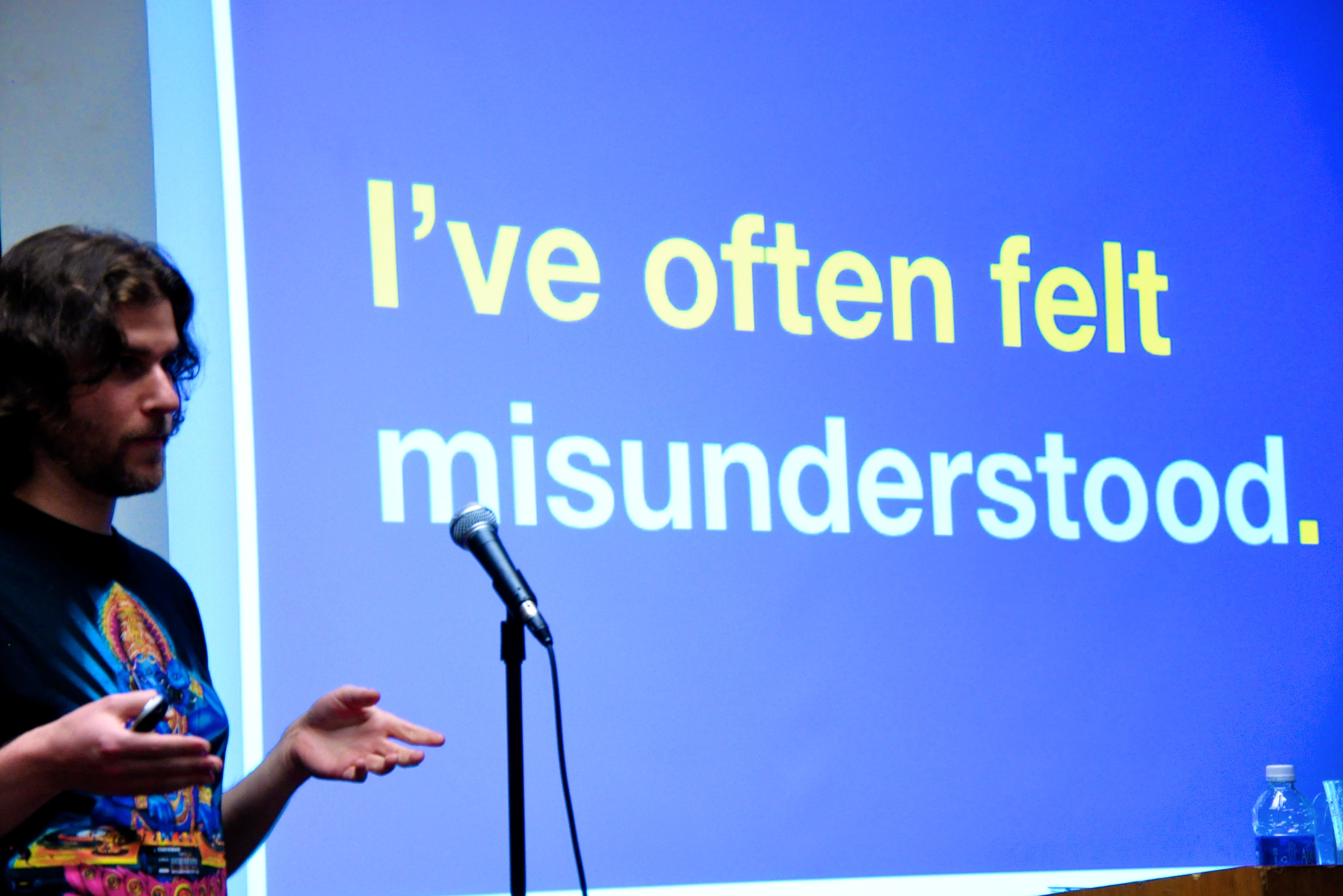
Misunderstood by Raffi Asdourian

Misunderstood by Raffi Asdourian

Academics are misunderstood.

Almost by definition.

Pretty much any academic eventually feels that s/he is misunderstood. Misunderstandings about some core notions in about any academic field are involved in some of the most common pet peeves among academics.

In other words, there’s nothing as transdisciplinary as misunderstanding.

It can happen in the close proximity of a given department (“colleagues in my department misunderstand my work”). It can happen through disciplinary boundaries (“people in that field have always misunderstood our field”). And, it can happen generally: “Nobody gets us.”

It’s not paranoia and it’s probably not self-victimization. But there almost seems to be a form of “onedownmanship” at stake with academics from different disciplines claiming that they’re more misunderstood than others. In fact, I personally get the feeling that ethnographers are more among the most misunderstood people around, but even short discussions with friends in other fields (including mathematics) have helped me get the idea that, basically, we’re all misunderstood at the same “level” but there are variations in the ways we’re misunderstood. For instance, anthropologists in general are mistaken for what they aren’t based on partial understanding by the general population.

An example from my own experience, related to my decision to call myself an “informal ethnographer.” When you tell people you’re an anthropologist, they form an image in their minds which is very likely to be inaccurate. But they do typically have an image in their minds. On the other hand, very few people have any idea about what “ethnography” means, so they’re less likely to form an opinion of what you do from prior knowledge. They may puzzle over the term and try to take a guess as to what “ethnographer” might mean but, in my experience, calling myself an “ethnographer” has been a more efficient way to be understood than calling myself an “anthropologist.”

This may all sound like nitpicking but, from the inside, it’s quite impactful. Linguists are frequently asked about the number of languages they speak. Mathematicians are taken to be number freaks. Psychologists are perceived through the filters of “pop psych.” There are many stereotypes associated with engineers. Etc.

These misunderstandings have an impact on anyone’s work. Not only can it be demoralizing and can it impact one’s sense of self-worth, but it can influence funding decisions as well as the use of research results. These misunderstandings can underminine learning across disciplines. In survey courses, basic misunderstandings can make things very difficult for everyone. At a rather basic level, academics fight misunderstandings more than they fight ignorance.

The  main reason I’m discussing this is that I’ve been given several occasions to think about the interface between the Ivory Tower and the rest of the world. It’s been a major theme in my blogposts about intellectuals, especially the ones in French. Two years ago, for instance, I wrote a post in French about popularizers. A bit more recently, I’ve been blogging about specific instances of misunderstandings associated with popularizers, including Malcolm Gladwell’s approach to expertise. Last year, I did a podcast episode about ethnography and the Ivory Tower. And, just within the past few weeks, I’ve been reading a few things which all seem to me to connect with this same issue: common misunderstandings about academic work. The connections are my own, and may not be so obvious to anyone else. But they’re part of my motivations to blog about this important issue.

In no particular order:

But, of course, I think about many other things. Including (again, in no particular order):

One discussion I remember, which seems to fit, included comments about Germaine Dieterlen by a friend who also did research in West Africa. Can’t remember the specifics but the gist of my friend’s comment was that “you get to respect work by the likes of Germaine Dieterlen once you start doing field research in the region.” In my academic background, appreciation of Germaine Dieterlen’s may not be unconditional, but it doesn’t necessarily rely on extensive work in the field. In other words, while some parts of Dieterlen’s work may be controversial and it’s extremely likely that she “got a lot of things wrong,” her work seems to be taken seriously by several French-speaking africanists I’ve met. And not only do I respect everyone but I would likely praise someone who was able to work in the field for so long. She’s not my heroine (I don’t really have heroes) or my role-model, but it wouldn’t have occurred to me that respect for her wasn’t widespread. If it had seemed that Dieterlen’s work had been misunderstood, my reflex would possibly have been to rehabilitate her.

In fact, there’s  a strong academic tradition of rehabilitating deceased scholars. The first example which comes to mind is a series of articles (PDF, in French) and book chapters by UWO linguistic anthropologist Regna Darnell.about “Benjamin Lee Whorf as a key figure in linguistic anthropology.” Of course, saying that these texts by Darnell constitute a rehabilitation of Whorf reveals a type of evaluation of her work. But that evaluation comes from a third person, not from me. The likely reason for this case coming up to my mind is that the so-called “Sapir-Whorf Hypothesis” is among the most misunderstood notions from linguistic anthropology. Moreover, both Whorf and Sapir are frequently misunderstood, which can make matters difficulty for many linguistic anthropologists talking with people outside the discipline.

The opposite process is also common: the “slaughtering” of “sacred cows.” (First heard about sacred cows through an article by ethnomusicologist Marcia Herndon.) In some significant ways, any scholar (alive or not) can be the object of not only critiques and criticisms but a kind of off-handed dismissal. Though this often happens within an academic context, the effects are especially lasting outside of academia. In other words, any scholar’s name is likely to be “sullied,” at one point or another. Typically, there seems to be a correlation between the popularity of a scholar and the likelihood of her/his reputation being significantly tarnished at some point in time. While there may still be people who treat Darwin, Freud, Nietzsche, Socrates, Einstein, or Rousseau as near divinities, there are people who will avoid any discussion about anything they’ve done or said. One way to put it is that they’re all misunderstood. Another way to put it is that their main insights have seeped through “common knowledge” but that their individual reputations have decreased.

Perhaps the most difficult case to discuss is that of Marx (Karl, not Harpo). Textbooks in introductory sociology typically have him as a key figure in the discipline and it seems clear that his insight on social issues was fundamental in social sciences. But, outside of some key academic contexts, his name is associated with a large series of social events about which people tend to have rather negative reactions. Even more so than for Paul de Man or  Martin Heidegger, Marx’s work is entangled in public opinion about his ideas. Haven’t checked for examples but I’m quite sure that Marx’s work is banned in a number of academic contexts. However, even some of Marx’s most ardent opponents are likely to agree with several aspects of Marx’s work and it’s sometimes funny how Marxian some anti-Marxists may be.

But I digress…

Typically, the “slaughtering of sacred cows” relates to disciplinary boundaries instead of social ones. At least, there’s a significant difference between your discipline’s own “sacred cows” and what you perceive another discipline’s “sacred cows” to be. Within a discipline, the process of dismissing a prior scholar’s work is almost œdipean (speaking of Freud). But dismissal of another discipline’s key figures is tantamount to a rejection of that other discipline. It’s one thing for a physicist to show that Newton was an alchemist. It’d be another thing entirely for a social scientist to deconstruct James Watson’s comments about race or for a theologian to argue with Darwin. Though discussions may have to do with individuals, the effects of the latter can widen gaps between scholarly disciplines.

And speaking of disciplinarity, there’s a whole set of issues having to do with discussions “outside of someone’s area of expertise.” On one side, comments made by academics about issues outside of their individual areas of expertise can be very tricky and can occasionally contribute to core misunderstandings. The fear of “talking through one’s hat” is quite significant, in no small part because a scholar’s prestige and esteem may greatly decrease as a result of some blatantly inaccurate statements (although some award-winning scholars seem not to be overly impacted by such issues).

On the other side, scholars who have to impart expert knowledge to people outside of their discipline  often have to “water down” or “boil down” their ideas and, in effect, oversimplifying these issues and concepts. Partly because of status (prestige and esteem), lowering standards is also very tricky. In some ways, this second situation may be more interesting. And it seems unavoidable.

How can you prevent misunderstandings when people may not have the necessary background to understand what you’re saying?

This question may reveal a rather specific attitude: “it’s their fault if they don’t understand.” Such an attitude may even be widespread. Seems to me, it’s not rare to hear someone gloating about other people “getting it wrong,” with the suggestion that “we got it right.”  As part of negotiations surrounding expert status, such an attitude could even be a pretty rational approach. If you’re trying to position yourself as an expert and don’t suffer from an “impostor syndrome,” you can easily get the impression that non-specialists have it all wrong and that only experts like you can get to the truth. Yes, I’m being somewhat sarcastic and caricatural, here. Academics aren’t frequently that dismissive of other people’s difficulties understanding what seem like simple concepts. But, in the gap between academics and the general population a special type of intellectual snobbery can sometimes be found.

Obviously, I have a lot more to say about misunderstood academics. For instance, I wanted to address specific issues related to each of the links above. I also had pet peeves about widespread use of concepts and issues like “communities” and “Eskimo words for snow” about which I sometimes need to vent. And I originally wanted this post to be about “cultural awareness,” which ends up being a core aspect of my work. I even had what I might consider a “neat” bit about public opinion. Not to mention my whole discussion of academic obfuscation (remind me about “we-ness and distinction”).

But this is probably long enough and the timing is right for me to do something else.

I’ll end with an unverified anecdote that I like. This anecdote speaks to snobbery toward academics.

[It's one of those anecdotes which was mentioned in a course I took a long time ago. Even if it's completely fallacious, it's still inspiring, like a tale, cautionary or otherwise.]

As the story goes (at least, what I remember of it), some ethnographers had been doing fieldwork  in an Australian cultural context and were focusing their research on a complex kinship system known in this context. Through collaboration with “key informants,” the ethnographers eventually succeeded in understanding some key aspects of this kinship system.

As should be expected, these kinship-focused ethnographers wrote accounts of this kinship system at the end of their field research and became known as specialists of this system.

After a while, the fieldworkers went back to the field and met with the same people who had described this kinship system during the initial field trip. Through these discussions with their “key informants,” the ethnographers end up hearing about a radically different kinship system from the one about which they had learnt, written, and taught.

The local informants then told the ethnographers: “We would have told you earlier about this but we didn’t think you were able to understand it.”

Moving On

[I'm typically not very good at going back to drafts and I don't have much time to write this. But I can RERO this. It's an iterative process in any case....]

Been thinking about different things which all relate to the same theme: changing course, seizing opportunities, shifting focus, adapting to new situations, starting over, getting a clean slate… Moving on.

One reason is that I recently decided to end my ethnography podcast. Not that major a decision and rather easy to make. Basically, I had stopped doing it but I had yet to officially end it. I had to make it clear, in my mind, that it’s not part of the things I’m doing, these days. Not that it was a big thing in my life but I had set reminders every month that I had to record a podcast episode. It worked for ten episode (in ten months) but, once I had missed one episode, the reminder was nagging me more than anything else.

In this sense, “moving on” is realistic/pragmatic. Found something similar in Getting Things Done, by David Allen.

It’s also similar to something Larry Lessig called “email bankruptcy,” as a step toward enhanced productivity.

In fact, even financial bankruptcy can relate to this, in some contexts. In Canada, at least, bankruptcy is most adequately described as a solution to a problem, not the problem itself. I’ve known some people who were able to completely rebuild their finances after declaring bankruptcy, sometimes even getting a better credit rating than someone who hadn’t gone bankrupt. I know how strongly some people may react to this concept of bankruptcy (based on principle, resentment, fears, hopes…). It’s an extreme example of what I mean by “moving on.” It goes well with the notion, quite common in North American cultural contexts, that you always deserve a second chance (but that you should do things yourself).

Of course, similar things happen with divorces which, similarly, can often be considered as solutions to a problem rather than the problem itself. No matter how difficult or how bad divorce might be, it’s a way to start over. In some sense, it’s less extreme an example as the bankruptcy one. But it may still generate negative vibes or stir negative emotions.

Because what I’m thinking about has more to do with “turning over a new leaf.” And taking the “leap of faith” which will make you go where you feel more comfortable. I’m especially thinking about all sorts of cases of people who decided to make radical changes in their professional or personal lives, often leaving a lot behind. Whether they were forced to implement such changes or decided to jump because they simply wanted to, all of the cases I remember have had positive outcomes.

It reminds me of a good friend of mine with whom I went through music school, in college. When he finished college, he decided to follow the music path and registered for the conservatory. But, pretty quickly, he realized that it wasn’t for him. Even though he had been intensely “in music” for several years, with days of entering the conservatory, he saw that music wasn’t to remain the central focus of his career. Through a conversation with a high school friend (who later became his wife and the mother of his children), he found out that it wasn’t too late for him to register for university courses. He had been thinking about phys. ed., and thought it might be a nice opportunity to try that path. He’s been a phys. ed. teacher for a number of years. We had lunch together last year and he seems very happy with his career choice. He also sounds like a very dedicated and effective phys. ed. teacher.

In my last podcast episode, I mentioned a few things about my views of this “change of course.” Including what has become something of an expression, for me: “Done with fish.” Comes from the movie Adaptation. The quote is found here (preceded by a bit of profanity). Basically, John Laroche, who was passionately dedicated to fish, decided to completely avoid anything having to do with fish. I can relate to this at some rather deep level.

I’m also thinking about the negative consequences of “sticking with” something which isn’t working, shifting too late or too quickly, implementing changes in inappropriate ways. Plenty of examples there. Most of the ones which come to my mind have to do with business settings. One which would require quite a bit of “explaining” is my perception of Google’s strategy with Wave. Put briefly (with the hope of revisiting this issue), I think Google made bad decisions with Wave, including killing it both too late and too early (no, I don’t see this as a contradiction; but I don’t have time to explain it). They also, I feel, botched a few transitions, in this. And, more importantly, I’d say that they failed to adapt the product to what was needed.

And the trigger for several of my reflections on this “moving on” idea have to do with this kind of adaptation (fun that the movie of that name should be involved, eh?). Twitter could be an inspiration, in this case. Not only did they, like Flickr, start through a switch away from another project, but Twitter was able to transform users’ habits into the basis for some key features. Hashtags and “@replies” are well-known examples. But you could even say that most of the things they’ve been announcing have been related to the way people use their tools.

So, in a way, it’s about the balance between vision and responsiveness. Vision is often discussed and it sounds to some people as a key thing in any “task-based group (from a team to a corporation). But the way a team can switch from one project to the next based on feedback (from users or other stakeholders) seems underrated. Although, there is some talk about the “startup mentality” in many contexts, including Google and Apple. Words which fit this semantic field include: “agile,” “flexible,” “pivot,” “lean,” and “nimble” (the latter word seemed to increase in currency after being used by Barack Obama in a speech).

Anyhoo… Gotta go.

But, just before I go: I am moving on with some things (including my podfade but also a shift away from homebrewing). But the key things in my life are very stable, especially my sentimental life.

Values of Content

Wannabe Guru: “There’s no such thing as free content.”

Literature Major: “Content’s a tale / Told by an idiot, full of sound and fury, / Signifying nothing.”

Arts Major: “Content Is in the Eye of the Beholder.”

Entertainer: “There’s no content / like show content / like no content I know.”

Journalist: “Content is my job and I deserve to be paid for what I make, the exact same way that a baker is paid for selling bread. What other people called ‘content’ isn’t really content since it hasn’t been vetted by professionals like my editor. So my role is to create content so that my editor can distribute it through exclusive channels. Other people’s content becomes my content when I secure the rights to it through the use of a clearance service. Comments by people I interview only become content after they sign a release. Everything else is noise.”

Economist: “There are four ways to get paid for content: a) subscription; b) advertising; c) private or public sponsorship; d) sale on media. Since advertising and sponsorship are two aspects of the same model and since consumers epend money on either subscription or media sales, there are two basic models.”

Functionalist (Sociology): “Content serves different goals, both manifest and latent.”
Conflict-Theorist (Sociology): “Providing free content is a way for the ruling class to make the audience into a commodity.”

Interactionist (Sociology): “Content provides meaning to social selves.”

Moralist: “Content Yourself.”

Buddhist: “Content breeds contentment.”

Christian: “Content begat content.”

Geek: “Content Wants to be Free.”

Judge: “Our mission is to balance the rights of content creators with those of content consumers.”

Cop: “There are three forms of content: content that is appropriate for everyone, content which is only appropriate to certain people, and content which isn’t appropriate for anyone.”

Teenage Boy: “Where can I find naked pictures of that cute girl in my class?”

Teenage Girl: “How can I get in touch with that dreamy guy in that video?”

Actively Reading: Organic Ideas for Startups

Been using Diigo as a way to annotate online texts. In this case, I was as interested in the tone as in the text itself. At the same time, I kept thinking about things which seem to be missing from Diigo.
Organic Startup Ideas

http://www.paulgraham.com/organic.html

One thing I like about this text is its tone. There’s an honesty, an ingenuity that I find rare in this type of writing.

  • startup ideas
    • The background is important, in terms of the type of ideas about which we’re constructing something.
  • what do you wish someone would make for you?
    • My own itch has to do with Diigo, actually. There’s a lot I wish Diigo would make for me. I may be perceived as an annoyance, but I think my wishlist may lead to something bigger and possibly quite successful.
    • The difference between this question and the “scratch your own itch” principle seems significant, and this distinction may have some implications in terms of success: we’re already talking about others, not just running ideas in our own head.
  • what do you wish someone would make for you?
    • It’s somewhat different from the well-known “scratch your own itch” principle. In this difference might be located something significant. In a way, part of the potential for this version to lead to success comes from the fact that it’s already connected with others, instead of being about running ideas in your own mind.
  • grow organically
    • The core topic of the piece, put in a comparative context. The comparison isn’t the one people tend to make and one may argue about the examples used. But the concept of organic ideas is fascinating and inspiring.
  • you decide, from afar,
    • What we call, in anthropology, the “armchair” approach. Also known as “backbenching.” For this to work, you need to have a deep knowledge of the situation, which is part of the point in this piece. Nice that it’s not demonizing this position but putting it in context.
  • Apple
    was the first type
    • One might argue that it was a hybrid case. Although, it does sound like the very beginnings of Apple weren’t about “thinking from afar.”
  • class of users other than you
    • Since developers are part of a very specific “class” of people, this isn’t insignificant a way to phrase this.
  • They still rely on this principle today, incidentally.
    The iPhone is the phone Steve Jobs wants.
    • Apple tends to be perceived in a different light. According to many people, it’s the “textbook example” of a company where decisions are made without concerns for what people need. “Steve Jobs uses a top-down approach,” “They don’t even use focus groups,” “They don’t let me use their tools the way I want to use them.” But we’re not talking about the same distinction between top-down and bottom-up. Though “organic ideas” seem to imply that it’s a grassroots/bottom-up phenomenon, the core distinction isn’t about the origin of the ideas (from the “top,” in both cases) but on the reasoning behind these ideas.
  • We didn’t need this software ourselves.
    • Sounds partly like a disclaimer but this approach is quite common and “there’s nothing wrong with it.”
  • comparatively old
    • Age and life experience make for an interesting angle. It’s not that this strategy needs people of a specific age to work. It’s that there’s a connection between one’s experience and the way things may pan out.
  • There is no sharp line between the two types of ideas,
    • Those in the “engineering worldview” might go nuts, at this point. I can hear the claims of “hand waving.” But we’re talking about something complex, here, not a merely complicated problem.
  • Apple type
    • One thing to note in the three examples here: they’re all made by pairs of guys. Jobs and Woz, Gates and Allen, Page and Brin. In many cases, the formula might be that one guy (or gal, one wishes) comes up with ideas knowing that the other can implement them. Again, it’s about getting somebody else to build it for you, not about scratching your own itch.
  • Bill Gates was writing something he would use
    • Again, Gates may not be the most obvious example, since he’s mostly known for another approach. It’s not inaccurate to say he was solving his own problem, at the time, but it may not be that convincing as an example.
  • Larry and Sergey when they wrote the first versions of Google.
    • Although, the inception of the original ideas was academic in context. They weren’t solving a search problem or thinking about monetization. They were discovering the power of CitationRank.
  • generally preferable
    • Nicely relativistic.
  • It takes experience
    to predict what other people will want.
    • And possibly a lot more. Interesting that he doesn’t mention empirical data.
  • young founders
    • They sound like a fascinating group to observe. They do wonders when they open up to others, but they seem to have a tendency to impose their worldviews.
  • I’d encourage you to focus initially on organic ideas
    • Now, this advice sounds more like the “scratch your own itch” advocation. But there’s a key difference in that it’s stated as part of a broader process. It’s more of a “walk before you run” or “do your homework” piece of advice, not a “you can’t come up with good ideas if you just think about how people will use your tool.”
  • missing or broken
    • It can cover a lot, but it’s couched in terms of the typical “problem-solving” approach at the centre of the engineering worldview. Since we’re talking about developing tools, it makes sense. But there could be a broader version, admitting for dreams, inspiration, aspiration. Not necessarily of the “what would make you happy?” kind, although there’s a lot to be said about happiness and imagination. You’re brainstorming, here.
  • immediate answers
    • Which might imply that there’s a second step. If you keep asking yourself the same question, you may be able to get a very large number of ideas. The second step could be to prioritize them but I prefer “outlining” as a process: you shuffle things together and you group some ideas to get one which covers several. What’s common between your need for a simpler way to code on the Altair and your values? Why do you care so much about algorithms instead of human encoding?
  • You may need to stand outside yourself a bit to see brokenness
    • Ah, yes! “Taking a step back,” “distancing yourself,” “seeing the forest for the trees”… A core dimension of the ethnographic approach and the need for a back-and-forth between “inside” and “outside.” There’s a reflexive component in this “being an outsider to yourself.” It’s not only psychological, it’s a way to get into the social, which can lead to broader success if it’s indeed not just about scratching your own itch.
  • get used to it and take it for granted
    • That’s enculturation, to you. When you do things a certain way simply because “we’ve always done them that way,” you may not create these organic ideas. But it’s a fine way to do your work. Asking yourself important questions about what’s wrong with your situation works well in terms of getting new ideas. But, sometimes, you need to get some work done.
  • a Facebook
    • Yet another recontextualized example. Zuckerberg wasn’t trying to solve that specific brokenness, as far as we know. But Facebook became part of what it is when Zuck began scratching that itch.
  • organic startup ideas usually don’t
    seem like startup ideas at first
    • Which gets us to the pivotal importance of working with others. Per this article, VCs and “angel investors,” probably. But, in the case of some of cases cited, those we tend to forget, like Paul Allen, Narendra, and the Winklevosses.
  • end up making
    something of value to a lot of people
    • Trial and error, it’s an iterative process. So you must recognize errors quickly and not invest too much effort in a specific brokenness. Part of this requires maturity.
  • something
    other people dismiss as a toy
    • The passage on which Gruber focused and an interesting tidbit. Not that central, come to think of it. But it’s important to note that people’s dismissive attitude may be misled, that “toys” may hide tools, that it’s probably a good idea not to take all feedback to heart…
  • At this point, when someone comes to us with
    something that users like but that we could envision forum trolls
    dismissing as a toy, it makes us especially likely to invest.
  • the best source of organic ones
    • Especially to investors. Potentially self-serving… in a useful way.
  • they’re at the forefront of technology
    • That part I would dispute, actually. Unless we talk about a specific subgroup of young founders and a specific set of tools. Young founders tend to be oblivious to a large field in technology, including social tools.
  • they’re in a position to discover
    valuable types of fixable brokenness first
    • The focus on fixable brokenness makes sense if we’re thinking exclusively through the engineering worldview, but it’s at the centre of some failures like the Google Buzz launch.
  • you still have to work hard
    • Of the “inspiration shouldn’t make use forget perspiration” kind. Makes for a more thoughtful approach than the frequent “all you need to do…” claims.
  • I’d encourage anyone
    starting a startup to become one of its users, however unnatural it
    seems.
    • Not merely an argument for dogfooding. It’s deeper than that. Googloids probably use Google tools but they didn’t actually become users. They’re beta testers with a strong background in troubleshooting. Not the best way to figure out what users really want or how the tool will ultimately fail.
  • It’s hard to compete directly with open source software
    • Open Source as competition isn’t new as a concept, but it takes time to seep in.
  • there has to be some part
    you can charge for
    • The breach through which old-school “business models” enter with little attention paid to everything else. To the extent that much of the whole piece might crumble from pressure built up by the “beancounter” worldview. Good thing he acknowledges it.

Why I Need an iPad

I’m one of those who feel the iPad is the right tool for the job.

This is mostly meant as a reply to this blogthread. But it’s also more generally about my personal reaction to Apple’s iPad announcement.

Some background.

I’m an ethnographer and a teacher. I read a fair deal, write a lot of notes, and work in a variety of contexts. These days, I tend to spend a good amount of time in cafés and other public places where I like to work without being too isolated. I also commute using public transit, listen to lots of podcast, and create my own. I’m also very aural.

I’ve used a number of PDAs, over the years, from a Newton MessagePad 130 (1997) to a variety of PalmOS devices (until 2008). In fact, some people readily associated me with PDA use.

As soon as I learnt about the iPod touch, I needed one. As soon as I’ve heard about the SafariPad, I wanted one. I’ve been an intense ‘touch user since the iPhone OS 2.0 release and I’m a happy camper.

(A major reason I never bought an iPhone, apart from price, is that it requires a contract.)

In my experience, the ‘touch is the most appropriate device for all sorts of activities which are either part of an other activity (reading during a commute) or are simply too short in duration to constitute an actual “computer session.” You don’t “sit down to work at your ‘touch” the way you might sit in front of a laptop or desktop screen. This works great for “looking up stufff” or “checking email.” It also makes a lot of sense during commutes in crowded buses or metros.

In those cases, the iPod touch is almost ideal. Ubiquitous access to Internet would be nice, but that’s not a deal-breaker. Alternative text-input methods would help in some cases, but I do end up being about as fast on my ‘touch as I was with Graffiti on PalmOS.

For other tasks, I have a Mac mini. Sure, it’s limited. But it does the job. In fact, I have no intention of switching for another desktop and I even have an eMachines collecting dust (it’s too noisy to make a good server).

What I miss, though, is a laptop. I used an iBook G3 for several years and loved it. For a little while later, I was able to share a MacBook with somebody else and it was a wonderful experience. I even got to play with the OLPC XO for a few weeks. That one was not so pleasant an experience but it did give me a taste for netbooks. And it made me think about other types of iPhone-like devices. Especially in educational contexts. (As I mentioned, I’m a teacher)

I’ve been laptop-less for a while, now. And though my ‘touch replaces it in many contexts, there are still times when I’d really need a laptop. And these have to do with what I might call “mobile sessions.”

For instance: liveblogging a conference or meeting. I’ve used my ‘touch for this very purpose on a good number of occasions. But it gets rather uncomfortable, after a while, and it’s not very fast. A laptop is better for this, with a keyboard and a larger form factor. But the iPad will be even better because of lower risks of RSI. A related example: just imagine TweetDeck on iPad.

Possibly my favourite example of a context in which the iPad will be ideal: presentations. Even before learning about the prospect of getting iWork on a tablet, presentations were a context in which I really missed a laptop.

Sure, in most cases, these days, there’s a computer (usually a desktop running XP) hooked to a projector. You just need to download your presentation file from Slideshare, show it from Prezi, or transfer it through USB. No biggie.

But it’s not the extra steps which change everything. It’s the uncertainty. Even if it’s often unfounded, I usually get worried that something might just not work, along the way. The slides might not show the same way as you see it because something is missing on that computer or that computer is simply using a different version of the presentation software. In fact, that software is typically Microsoft PowerPoint which, while convenient, fits much less in my workflow than does Apple Keynote.

The other big thing about presentations is the “presenter mode,” allowing you to get more content than (or different content from) what the audience sees. In most contexts where I’ve used someone else’s computer to do a presentation, the projector was mirroring the computer’s screen, not using it as a different space. PowerPoint has this convenient “presenter view” but very rarely did I see it as an available option on “the computer in the room.” I wish I could use my ‘touch to drive presentations, which I could do if I installed software on that “computer in the room.” But it’s not something that is likely to happen, in most cases.

A MacBook solves all of these problems. and it’s an obvious use for laptops. But how, then, is the iPad better? Basically because of interface. Switching slides on a laptop isn’t hard, but it’s more awkward than we realize. Even before watching the demo of Keynote on the iPad, I could simply imagine the actual pleasure of flipping through slides using a touch interface. The fit is “natural.”

I sincerely think that Keynote on the iPad will change a number of things, for me. Including the way I teach.

Then, there’s reading.

Now, I’m not one of those people who just can’t read on a computer screen. In fact, I even grade assignments directly from the screen. But I must admit that online reading hasn’t been ideal, for me. I’ve read full books as PDF files or dedicated formats on PalmOS, but it wasn’t so much fun, in terms of the reading process. And I’ve used my ‘touch to read things through Stanza or ReadItLater. But it doesn’t work so well for longer reading sessions. Even in terms of holding the ‘touch, it’s not so obvious. And, what’s funny, even a laptop isn’t that ideal, for me, as a reading device. In a sense, this is when the keyboard “gets in the way.”

Sure, I could get a Kindle. I’m not a big fan of dedicated devices and, at least on paper, I find the Kindle a bit limited for my needs. Especially in terms of sources. I’d like to be able to use documents in a variety of formats and put them in a reading list, for extended reading sessions. No, not “curled up in bed.” But maybe lying down in a sofa without external lighting. Given my experience with the ‘touch, the iPad is very likely the ideal device for this.

Then, there’s the overall “multi-touch device” thing. People have already been quite creative with the small touchscreen on iPhones and ‘touches, I can just imagine what may be done with a larger screen. Lots has been said about differences in “screen real estate” in laptop or desktop screens. We all know it can make a big difference in terms of what you can display at the same time. In some cases, two screens isn’t even a luxury, for instance when you code and display a page at the same time (LaTeX, CSS…). Certainly, the same qualitative difference applies to multitouch devices. Probably even more so, since the display is also used for input. What Han found missing in the iPhone’s multitouch was the ability to use both hands. With the iPad, Han’s vision is finding its space.

Oh, sure, the iPad is very restricted. For instance, it’s easy to imagine how much more useful it’d be if it did support multitasking with third-party apps. And a front-facing camera is something I was expecting in the first iPhone. It would just make so much sense that a friend seems very disappointed by this lack of videoconferencing potential. But we’re probably talking about predetermined expectations, here. We’re comparing the iPad with something we had in mind.

Then, there’s the issue of the competition. Tablets have been released and some multitouch tablets have recently been announced. What makes the iPad better than these? Well, we could all get in the same OS wars as have been happening with laptops and desktops. In my case, the investment in applications, files, and expertise that I have made in a Mac ecosystem rendered my XP years relatively uncomfortable and me appreciate returning to the Mac. My iPod touch fits right in that context. Oh, sure, I could use it with a Windows machine, which is in fact what I did for the first several months. But the relationship between the iPhone OS and Mac OS X is such that using devices in those two systems is much more efficient, in terms of my own workflow, than I could get while using XP and iPhone OS. There are some technical dimensions to this, such as the integration between iCal and the iPhone OS Calendar, or even the filesystem. But I’m actually thinking more about the cognitive dimensions of recognizing some of the same interface elements. “Look and feel” isn’t just about shiny and “purty.” It’s about interactions between a human brain, a complex sensorimotor apparatus, and a machine. Things go more quickly when you don’t have to think too much about where some tools are, as you’re working.

So my reasons for wanting an iPad aren’t about being dazzled by a revolutionary device. They are about the right tool for the job.