Academics and Their Publics

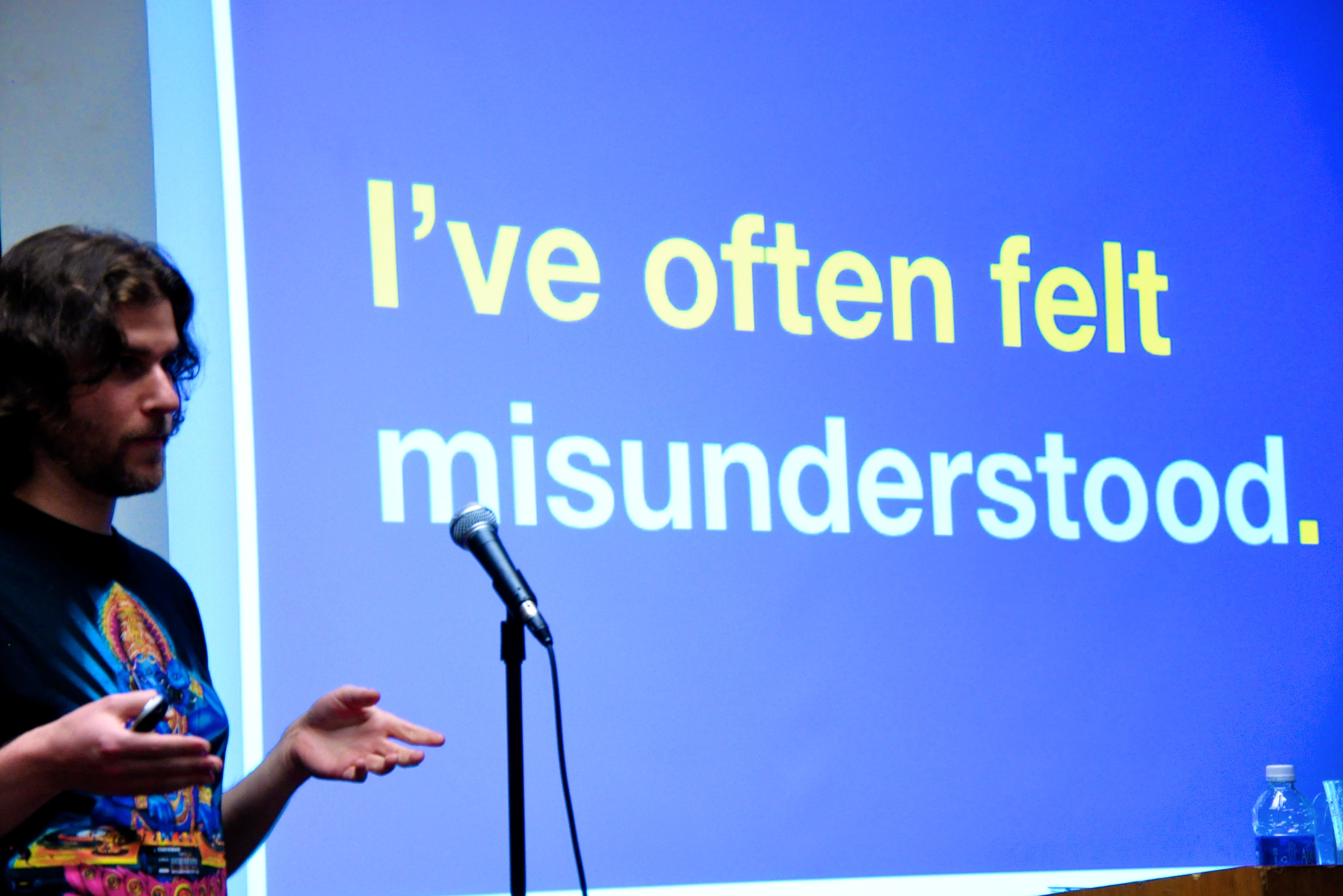
Misunderstood by Raffi Asdourian

Misunderstood by Raffi Asdourian

Academics are misunderstood.

Almost by definition.

Pretty much any academic eventually feels that s/he is misunderstood. Misunderstandings about some core notions in about any academic field are involved in some of the most common pet peeves among academics.

In other words, there’s nothing as transdisciplinary as misunderstanding.

It can happen in the close proximity of a given department (“colleagues in my department misunderstand my work”). It can happen through disciplinary boundaries (“people in that field have always misunderstood our field”). And, it can happen generally: “Nobody gets us.”

It’s not paranoia and it’s probably not self-victimization. But there almost seems to be a form of “onedownmanship” at stake with academics from different disciplines claiming that they’re more misunderstood than others. In fact, I personally get the feeling that ethnographers are more among the most misunderstood people around, but even short discussions with friends in other fields (including mathematics) have helped me get the idea that, basically, we’re all misunderstood at the same “level” but there are variations in the ways we’re misunderstood. For instance, anthropologists in general are mistaken for what they aren’t based on partial understanding by the general population.

An example from my own experience, related to my decision to call myself an “informal ethnographer.” When you tell people you’re an anthropologist, they form an image in their minds which is very likely to be inaccurate. But they do typically have an image in their minds. On the other hand, very few people have any idea about what “ethnography” means, so they’re less likely to form an opinion of what you do from prior knowledge. They may puzzle over the term and try to take a guess as to what “ethnographer” might mean but, in my experience, calling myself an “ethnographer” has been a more efficient way to be understood than calling myself an “anthropologist.”

This may all sound like nitpicking but, from the inside, it’s quite impactful. Linguists are frequently asked about the number of languages they speak. Mathematicians are taken to be number freaks. Psychologists are perceived through the filters of “pop psych.” There are many stereotypes associated with engineers. Etc.

These misunderstandings have an impact on anyone’s work. Not only can it be demoralizing and can it impact one’s sense of self-worth, but it can influence funding decisions as well as the use of research results. These misunderstandings can underminine learning across disciplines. In survey courses, basic misunderstandings can make things very difficult for everyone. At a rather basic level, academics fight misunderstandings more than they fight ignorance.

The  main reason I’m discussing this is that I’ve been given several occasions to think about the interface between the Ivory Tower and the rest of the world. It’s been a major theme in my blogposts about intellectuals, especially the ones in French. Two years ago, for instance, I wrote a post in French about popularizers. A bit more recently, I’ve been blogging about specific instances of misunderstandings associated with popularizers, including Malcolm Gladwell’s approach to expertise. Last year, I did a podcast episode about ethnography and the Ivory Tower. And, just within the past few weeks, I’ve been reading a few things which all seem to me to connect with this same issue: common misunderstandings about academic work. The connections are my own, and may not be so obvious to anyone else. But they’re part of my motivations to blog about this important issue.

In no particular order:

But, of course, I think about many other things. Including (again, in no particular order):

One discussion I remember, which seems to fit, included comments about Germaine Dieterlen by a friend who also did research in West Africa. Can’t remember the specifics but the gist of my friend’s comment was that “you get to respect work by the likes of Germaine Dieterlen once you start doing field research in the region.” In my academic background, appreciation of Germaine Dieterlen’s may not be unconditional, but it doesn’t necessarily rely on extensive work in the field. In other words, while some parts of Dieterlen’s work may be controversial and it’s extremely likely that she “got a lot of things wrong,” her work seems to be taken seriously by several French-speaking africanists I’ve met. And not only do I respect everyone but I would likely praise someone who was able to work in the field for so long. She’s not my heroine (I don’t really have heroes) or my role-model, but it wouldn’t have occurred to me that respect for her wasn’t widespread. If it had seemed that Dieterlen’s work had been misunderstood, my reflex would possibly have been to rehabilitate her.

In fact, there’s  a strong academic tradition of rehabilitating deceased scholars. The first example which comes to mind is a series of articles (PDF, in French) and book chapters by UWO linguistic anthropologist Regna Darnell.about “Benjamin Lee Whorf as a key figure in linguistic anthropology.” Of course, saying that these texts by Darnell constitute a rehabilitation of Whorf reveals a type of evaluation of her work. But that evaluation comes from a third person, not from me. The likely reason for this case coming up to my mind is that the so-called “Sapir-Whorf Hypothesis” is among the most misunderstood notions from linguistic anthropology. Moreover, both Whorf and Sapir are frequently misunderstood, which can make matters difficulty for many linguistic anthropologists talking with people outside the discipline.

The opposite process is also common: the “slaughtering” of “sacred cows.” (First heard about sacred cows through an article by ethnomusicologist Marcia Herndon.) In some significant ways, any scholar (alive or not) can be the object of not only critiques and criticisms but a kind of off-handed dismissal. Though this often happens within an academic context, the effects are especially lasting outside of academia. In other words, any scholar’s name is likely to be “sullied,” at one point or another. Typically, there seems to be a correlation between the popularity of a scholar and the likelihood of her/his reputation being significantly tarnished at some point in time. While there may still be people who treat Darwin, Freud, Nietzsche, Socrates, Einstein, or Rousseau as near divinities, there are people who will avoid any discussion about anything they’ve done or said. One way to put it is that they’re all misunderstood. Another way to put it is that their main insights have seeped through “common knowledge” but that their individual reputations have decreased.

Perhaps the most difficult case to discuss is that of Marx (Karl, not Harpo). Textbooks in introductory sociology typically have him as a key figure in the discipline and it seems clear that his insight on social issues was fundamental in social sciences. But, outside of some key academic contexts, his name is associated with a large series of social events about which people tend to have rather negative reactions. Even more so than for Paul de Man or  Martin Heidegger, Marx’s work is entangled in public opinion about his ideas. Haven’t checked for examples but I’m quite sure that Marx’s work is banned in a number of academic contexts. However, even some of Marx’s most ardent opponents are likely to agree with several aspects of Marx’s work and it’s sometimes funny how Marxian some anti-Marxists may be.

But I digress…

Typically, the “slaughtering of sacred cows” relates to disciplinary boundaries instead of social ones. At least, there’s a significant difference between your discipline’s own “sacred cows” and what you perceive another discipline’s “sacred cows” to be. Within a discipline, the process of dismissing a prior scholar’s work is almost œdipean (speaking of Freud). But dismissal of another discipline’s key figures is tantamount to a rejection of that other discipline. It’s one thing for a physicist to show that Newton was an alchemist. It’d be another thing entirely for a social scientist to deconstruct James Watson’s comments about race or for a theologian to argue with Darwin. Though discussions may have to do with individuals, the effects of the latter can widen gaps between scholarly disciplines.

And speaking of disciplinarity, there’s a whole set of issues having to do with discussions “outside of someone’s area of expertise.” On one side, comments made by academics about issues outside of their individual areas of expertise can be very tricky and can occasionally contribute to core misunderstandings. The fear of “talking through one’s hat” is quite significant, in no small part because a scholar’s prestige and esteem may greatly decrease as a result of some blatantly inaccurate statements (although some award-winning scholars seem not to be overly impacted by such issues).

On the other side, scholars who have to impart expert knowledge to people outside of their discipline  often have to “water down” or “boil down” their ideas and, in effect, oversimplifying these issues and concepts. Partly because of status (prestige and esteem), lowering standards is also very tricky. In some ways, this second situation may be more interesting. And it seems unavoidable.

How can you prevent misunderstandings when people may not have the necessary background to understand what you’re saying?

This question may reveal a rather specific attitude: “it’s their fault if they don’t understand.” Such an attitude may even be widespread. Seems to me, it’s not rare to hear someone gloating about other people “getting it wrong,” with the suggestion that “we got it right.”  As part of negotiations surrounding expert status, such an attitude could even be a pretty rational approach. If you’re trying to position yourself as an expert and don’t suffer from an “impostor syndrome,” you can easily get the impression that non-specialists have it all wrong and that only experts like you can get to the truth. Yes, I’m being somewhat sarcastic and caricatural, here. Academics aren’t frequently that dismissive of other people’s difficulties understanding what seem like simple concepts. But, in the gap between academics and the general population a special type of intellectual snobbery can sometimes be found.

Obviously, I have a lot more to say about misunderstood academics. For instance, I wanted to address specific issues related to each of the links above. I also had pet peeves about widespread use of concepts and issues like “communities” and “Eskimo words for snow” about which I sometimes need to vent. And I originally wanted this post to be about “cultural awareness,” which ends up being a core aspect of my work. I even had what I might consider a “neat” bit about public opinion. Not to mention my whole discussion of academic obfuscation (remind me about “we-ness and distinction”).

But this is probably long enough and the timing is right for me to do something else.

I’ll end with an unverified anecdote that I like. This anecdote speaks to snobbery toward academics.

[It's one of those anecdotes which was mentioned in a course I took a long time ago. Even if it's completely fallacious, it's still inspiring, like a tale, cautionary or otherwise.]

As the story goes (at least, what I remember of it), some ethnographers had been doing fieldwork  in an Australian cultural context and were focusing their research on a complex kinship system known in this context. Through collaboration with “key informants,” the ethnographers eventually succeeded in understanding some key aspects of this kinship system.

As should be expected, these kinship-focused ethnographers wrote accounts of this kinship system at the end of their field research and became known as specialists of this system.

After a while, the fieldworkers went back to the field and met with the same people who had described this kinship system during the initial field trip. Through these discussions with their “key informants,” the ethnographers end up hearing about a radically different kinship system from the one about which they had learnt, written, and taught.

The local informants then told the ethnographers: “We would have told you earlier about this but we didn’t think you were able to understand it.”

Moving On

[I'm typically not very good at going back to drafts and I don't have much time to write this. But I can RERO this. It's an iterative process in any case....]

Been thinking about different things which all relate to the same theme: changing course, seizing opportunities, shifting focus, adapting to new situations, starting over, getting a clean slate… Moving on.

One reason is that I recently decided to end my ethnography podcast. Not that major a decision and rather easy to make. Basically, I had stopped doing it but I had yet to officially end it. I had to make it clear, in my mind, that it’s not part of the things I’m doing, these days. Not that it was a big thing in my life but I had set reminders every month that I had to record a podcast episode. It worked for ten episode (in ten months) but, once I had missed one episode, the reminder was nagging me more than anything else.

In this sense, “moving on” is realistic/pragmatic. Found something similar in Getting Things Done, by David Allen.

It’s also similar to something Larry Lessig called “email bankruptcy,” as a step toward enhanced productivity.

In fact, even financial bankruptcy can relate to this, in some contexts. In Canada, at least, bankruptcy is most adequately described as a solution to a problem, not the problem itself. I’ve known some people who were able to completely rebuild their finances after declaring bankruptcy, sometimes even getting a better credit rating than someone who hadn’t gone bankrupt. I know how strongly some people may react to this concept of bankruptcy (based on principle, resentment, fears, hopes…). It’s an extreme example of what I mean by “moving on.” It goes well with the notion, quite common in North American cultural contexts, that you always deserve a second chance (but that you should do things yourself).

Of course, similar things happen with divorces which, similarly, can often be considered as solutions to a problem rather than the problem itself. No matter how difficult or how bad divorce might be, it’s a way to start over. In some sense, it’s less extreme an example as the bankruptcy one. But it may still generate negative vibes or stir negative emotions.

Because what I’m thinking about has more to do with “turning over a new leaf.” And taking the “leap of faith” which will make you go where you feel more comfortable. I’m especially thinking about all sorts of cases of people who decided to make radical changes in their professional or personal lives, often leaving a lot behind. Whether they were forced to implement such changes or decided to jump because they simply wanted to, all of the cases I remember have had positive outcomes.

It reminds me of a good friend of mine with whom I went through music school, in college. When he finished college, he decided to follow the music path and registered for the conservatory. But, pretty quickly, he realized that it wasn’t for him. Even though he had been intensely “in music” for several years, with days of entering the conservatory, he saw that music wasn’t to remain the central focus of his career. Through a conversation with a high school friend (who later became his wife and the mother of his children), he found out that it wasn’t too late for him to register for university courses. He had been thinking about phys. ed., and thought it might be a nice opportunity to try that path. He’s been a phys. ed. teacher for a number of years. We had lunch together last year and he seems very happy with his career choice. He also sounds like a very dedicated and effective phys. ed. teacher.

In my last podcast episode, I mentioned a few things about my views of this “change of course.” Including what has become something of an expression, for me: “Done with fish.” Comes from the movie Adaptation. The quote is found here (preceded by a bit of profanity). Basically, John Laroche, who was passionately dedicated to fish, decided to completely avoid anything having to do with fish. I can relate to this at some rather deep level.

I’m also thinking about the negative consequences of “sticking with” something which isn’t working, shifting too late or too quickly, implementing changes in inappropriate ways. Plenty of examples there. Most of the ones which come to my mind have to do with business settings. One which would require quite a bit of “explaining” is my perception of Google’s strategy with Wave. Put briefly (with the hope of revisiting this issue), I think Google made bad decisions with Wave, including killing it both too late and too early (no, I don’t see this as a contradiction; but I don’t have time to explain it). They also, I feel, botched a few transitions, in this. And, more importantly, I’d say that they failed to adapt the product to what was needed.

And the trigger for several of my reflections on this “moving on” idea have to do with this kind of adaptation (fun that the movie of that name should be involved, eh?). Twitter could be an inspiration, in this case. Not only did they, like Flickr, start through a switch away from another project, but Twitter was able to transform users’ habits into the basis for some key features. Hashtags and “@replies” are well-known examples. But you could even say that most of the things they’ve been announcing have been related to the way people use their tools.

So, in a way, it’s about the balance between vision and responsiveness. Vision is often discussed and it sounds to some people as a key thing in any “task-based group (from a team to a corporation). But the way a team can switch from one project to the next based on feedback (from users or other stakeholders) seems underrated. Although, there is some talk about the “startup mentality” in many contexts, including Google and Apple. Words which fit this semantic field include: “agile,” “flexible,” “pivot,” “lean,” and “nimble” (the latter word seemed to increase in currency after being used by Barack Obama in a speech).

Anyhoo… Gotta go.

But, just before I go: I am moving on with some things (including my podfade but also a shift away from homebrewing). But the key things in my life are very stable, especially my sentimental life.

Values of Content

Wannabe Guru: “There’s no such thing as free content.”

Literature Major: “Content’s a tale / Told by an idiot, full of sound and fury, / Signifying nothing.”

Arts Major: “Content Is in the Eye of the Beholder.”

Entertainer: “There’s no content / like show content / like no content I know.”

Journalist: “Content is my job and I deserve to be paid for what I make, the exact same way that a baker is paid for selling bread. What other people called ‘content’ isn’t really content since it hasn’t been vetted by professionals like my editor. So my role is to create content so that my editor can distribute it through exclusive channels. Other people’s content becomes my content when I secure the rights to it through the use of a clearance service. Comments by people I interview only become content after they sign a release. Everything else is noise.”

Economist: “There are four ways to get paid for content: a) subscription; b) advertising; c) private or public sponsorship; d) sale on media. Since advertising and sponsorship are two aspects of the same model and since consumers epend money on either subscription or media sales, there are two basic models.”

Functionalist (Sociology): “Content serves different goals, both manifest and latent.”
Conflict-Theorist (Sociology): “Providing free content is a way for the ruling class to make the audience into a commodity.”

Interactionist (Sociology): “Content provides meaning to social selves.”

Moralist: “Content Yourself.”

Buddhist: “Content breeds contentment.”

Christian: “Content begat content.”

Geek: “Content Wants to be Free.”

Judge: “Our mission is to balance the rights of content creators with those of content consumers.”

Cop: “There are three forms of content: content that is appropriate for everyone, content which is only appropriate to certain people, and content which isn’t appropriate for anyone.”

Teenage Boy: “Where can I find naked pictures of that cute girl in my class?”

Teenage Girl: “How can I get in touch with that dreamy guy in that video?”

What Not to Tweet

Here’s a list I tweeted earlier.

Twenty Things You Should Never, Ever Tweet for Fear of Retaliation from the Tweet Police

  1. Lists. Too difficult to follow.
  2. Do’s and don’ts. Who died and made you bandleader?
  3. Personal thoughts. Nobody cares what anyone else thinks, anyway.
  4. Anything in a foreign language. It confuses everyone.
  5. Personal opinions. You may offend someone.
  6. Jokes. Same reason as #5.
  7. Links. Too dangerous, since some could be malicious.
  8. Anything in “the second degree.” The bareness of context prevents careful reading.
  9. Anything insightful. Who do you think you are?
  10. Personal replies. Can’t you get a room?
  11. -20: What @oatmeal said you shouldn’t tweet. If it’s funny, it must be true.

In case it wasn’t clear… Yes, I mean this as sarcasm. One of my pet peeves is to hear people tell others what to do or not to do, without appropriate context. It’s often perceived to be funny or useful but, to be honest, it just rubs me the wrong way. Sure, they’re allowed to do it. I won’t prevent them. I don’t even think they should stop, that’s really not for me to decide. It’s just that, being honest with myself, I realize how negative of an effect it has on me. It actually reaches waaaaay down into something I don’t care to visit very often.

The Oatmeal can be quite funny. Reading a few of these comics, recently, I literally LOLed. And this one probably pleased a lot of people, because it described some of their own pet peeves. Besides, it’s an old comic, probably coming from a time when tweets were really considered to be answers to the original Twitter prompt: “What are you doing?” (i.e., before the change to the somewhat more open “What’s happening?”). But I’ve heard enough expressions of what people should or shouldn’t do with a specific social media system that I felt the need to vent. So, that was the equivalent of a rant (and this post is closer to an actual rant).

I mean, there’s a huge difference between saying “these are the kinds of uses for which I think Twitter is the appropriate tool” and the flat-out dismissal of what others have done. While Twitter is old news, as social media go, it’s still unfolding and much of its strength comes from the fact that we don’t actually have a rigid notion of what it should be.

Not that there aren’t uses of Twitter I dislike. In fact, for much of 2009, I felt it was becoming too commercial for my taste. I felt there was too much promotion of commercial entities and products, and that it was relatively difficult to avoid such promotional tweets if one were to follow the reciprocation principle (“I really should make sure I follow those who follow me, even if a large proportion of them are just trying to increase their follower counts”). But none of this means that “Twitter isn’t for commercial promotion.” Structurally, Twitter almost seems to be made for such uses. Conceptually, it comes from the same “broadcast” view of communication, shared by many marketers, advertisers, PR experts, and movie producers. As social media tools go, Twitter is among the most appropriate ones to use to broadly distribute focused messages without having to build social relationships. So, no matter how annoyed I may get at these tweets and at commercial Twitterers, it’d be inaccurate to say that “Twitter isn’t for that.” Besides, “Twitter, Inc.” has adopted commercial promotion as a major part of its “business model.” No matter what one feels about this (say, that it’s not very creative or that it will help distinguish between commercial tweets and the rest of Twitter traffic), it seems to imply that Twitter is indeed about commercial promotion as much as it is about “shar[ing] and discover[ing] what’s happening now.”

The same couldn’t be said about other forms of tweeting that others may dislike. It’d be much harder to make a case for, say, conference liveblogging as being an essential part of what Twitter is about. In fact, some well-known and quite vocal people have made pronouncements about how inappropriate, in their minds, such a practice was. To me, much of it sounds like attempts at rationalizing a matter of individual preference. Some may dislike it but Twitter does make a very interesting platform for liveblogging conferences. Sure, we’ve heard about the negative consequences of the Twitter backchannel at some high-profile events. And there are some technical dimensions of Twitter which make liveblogging potentially more annoying, to some users, than if it were on another platform. But claiming that Twitter isn’t for liveblogging  reveals a rather rigid perspective of what social media can be. Again, one of the major strengths in Twitter is its flexibility. From “mentions” and “hashtags” to “retweets” and metadata, the platform has been developing over time based on usage patterns.

For one thing, it’s now much more conversational than it was in 2007, and some Twitter advocates are quite proud of that. So one might think that Twitter is for conversation. But, at least in my experience, Twitter isn’t that effective a tool for two-way communication let alone for conversations involving more than two people. So, if we’re to use conversation to evaluate Twitter (as its development may suggest we should do), it seems not to be that successful.

In this blog version of my list, I added a header with a mention of the “Tweet Police.” I mean it in the way that people talk about the “Fashion Police,” wish immediately makes me think about “fashion victims,” the beauty myth, the objectification of the human body, the social pressure to conform to some almost-arbitrary canons, the power struggles between those who decide what’s fashionable and those who need to dress fashionably to be accepted in some social contexts, etc. Basically, it leads to rather unpleasant thoughts. In a way, my mention of the “Tweet Police” is a strategy to “fight this demon” by showing how absurd it may become. Sure, it’d be a very tricky strategy if it were about getting everyone to just “get the message.” But, in this case, it’s about doing something which feels good. It’s my birthday, so I allow myself to do this.

Jazz and Identity: Comment on Lydon's Iyer Interview

Radio Open Source » Blog Archive » Vijay Iyer’s Life in Music: “Striving is the Back Story…”.

Sounds like it will be a while before the United States becomes a truly post-racial society.

Iyer can define himself as American and he can even one-up other US citizens in Americanness, but he’s still defined by his having “a Brahmin Indian name and heritage, and a Yale degree in physics.”

Something by which I was taken aback, at IU Bloomington ten years ago, is the fact that those who were considered to be “of color” (as if colour were the factor!) were expected to mostly talk about their “race” whereas those who were considered “white” were expected to remain silent when notions of “race” and ethnicity came up for discussion. Granted, ethnicity and “race” were frequently discussed, so it was possible to hear the voices of those “of color” on a semi-regular basis. Still, part of my culture shock while living in the MidWest was the conspicuous silence of students with brilliant ideas who happened to be considered African-American.

Something similar happened with gender, on occasion, in that women were strongly encouraged to speak out…when a gender angle was needed. Thankfully, some of these women (at least, among those whose “racial” identity was perceived as neutral) did speak up, regardless of topic. But there was still an expectation that when they did, their perspective was intimately gendered.

Of course, some gender lines were blurred: the gender ratio among faculty members was relatively balanced (probably more women than men), the chair of the department was a woman for a time, and one department secretary was a man. But women’s behaviours were frequently interpreted in a gender-specific way, while men were often treated as almost genderless. Male privilege manifested itself in the fact that it was apparently difficult for women not to be gender-conscious.

Those of us who were “international students” had the possibility to decide when our identities were germane to the discussion. At least, I was able to push my «différence» when I so pleased, often by becoming the token Francophone in discussions about Francophone scholars, yet being able not to play the “Frenchie card” when I didn’t find it necessary. At the same time, my behaviour may have been deemed brash and a fellow student teased me by calling me “Mr. Snottyhead.” As an instructor later told me, “it’s just that, since you’re Canadian, we didn’t expect you to be so different.” (My response: “I know some Canadians who would despise that comment. But since I’m Québécois, it doesn’t matter.”) This was in reference to a seminar with twenty students, including seven “internationals”: one Zimbabwean, one Swiss-German, two Koreans, one Japanese, one Kenyan, and one “Québécois of Swiss heritage.” In this same graduate seminar, the instructor expected everyone to know of Johnny Appleseed and of John Denver.

Again, a culture shock. Especially for someone coming from a context in which the ethnic identity of the majority is frequently discussed and in which cultural identity is often “achieved” instead of being ascribed. This isn’t to say that Quebec society is devoid of similar issues. Everybody knows, Quebec has more than its fair share of identity-based problems. The fact of the matter is, Quebec society is entangled in all sorts of complex identity issues, and for many of those, Quebec may appear underprepared. The point is precisely that, in Quebec, identity politics is a matter for everyone. Nobody has the luxury to treat their identity as “neutral.”

Going back to Iyer… It’s remarkable that his thoughtful comments on Jazz end up associated more with his background than with his overall approach. As if what he had to say were of a different kind than those from Roy Hayes or Robin Kelley. As if Iyer had more in common with Koo Nimo than with, say, Sonny Rollins. Given Lydon’s journalistic background, it’s probably significant that the Iyer conversation carried the “Life in Music” name of  the show’s music biography series yet got “filed under” the show’s “Year of India” series. I kid you not.

And this is what we hear at the end of each episode’s intro:

This is Open Source, from the Watson Institute at Brown University. An American conversation with Global attitude, we call it.

Guess the “American” part was taken by Jazz itself, so Iyer was assigned the “Global” one. Kind of wishing the roles were reversed, though Iyer had rehearsed his part.

But enough symbolic interactionism. For now.

During Lydon’s interview with Iyer, I kept being reminded of a conversation (in Brookline)  with fellow Canadian-ethnomusicologist-and-Jazz-musician Tanya Kalmanovitch. Kalmanovitch had fantastic insight to share on identity politics at play through the international (yet not post-national) Jazz scene. In fact, methinks she’d make a great Open Source guest. She lives in Brooklyn but works as assistant chair of contemporary improv at NEC, in B-Town, so Lydon could probably meet her locally.

Anyhoo…

In some ways, Jazz is more racialized and ethnicized now than it was when Howie Becker published Outsiders. (hey, I did hint symbolic interactionism’d be back!). It’s also very national, gendered, compartmentalized… In a word: modern. Of course, Jazz (or something like it) shall play a role in postmodernity. But only if it sheds itself of its modernist trappings. We should hear out Kevin Mahogany’s (swung) comments about a popular misconception:

Some cats work from nine to five
Change their life for line of jive
Never had foresight to see
Where the changes had to be
Thought that they had heard the word
Thought it all died after Bird
But we’re still swingin’

The following anecdote seems à propos.

Branford Marsalis quartet on stage outside at the Indy Jazz Fest 1999. Some dude in the audience starts heckling the band: “Play something we know!” Marsalis, not losing his cool, engaged the heckler in a conversation on Jazz history, pushing the envelope, playing the way you want to play, and expected behaviour during shows. Though the audience sounded divided when Marsalis advised the heckler to go to Chaka Khan‘s show on the next stage over, if that was more to the heckler’s liking, there wasn’t a major shift in the crowd and, hopefully, most people understood how respectful Marsalis’s comments really were. What was especially precious is when Marsalis asked the heckler: “We’re cool, man?”

It’s nothing personal.

In Phase

Lissajous curve

Lissajous curve

Something which happens to me on a rather regular basis (and about which I blogged before) is that I’ll hear about something right after thinking about it. For instance, if I think about the fact that a given tool should exist, it may be announced right at that moment.

Hey, I was just thinking about this!

The effect is a bit strange but it’s quite easy to explain. It feels like a “premonition,” but it probably has more to do with “being in phase.” In some cases, it may also be that I heard about that something but hadn’t registered the information. I know it happens a lot and  it might not be too hard to trace back. But I prefer thinking about phase.

And, yes, I am thinking about phase difference in waves. Not in a very precise sense, but the image still works, for me. Especially with the Lissajous representation, as above.

See, I don’t particularly want to be “ahead of the curve” and I don’t particularly mind being “behind the curve.” But when I’m right “in the curve,” something interesting happens. I’m “in the now.”

I originally thought about being “in tune” and it could also be about “in sync” or even “matching impedances.” But I still like the waves analogy. Especially since, when two waves are in phase, they reinforce one another. As analogies go, it’s not only a beautiful one, but a powerful one. And, yes, I do think about my sweetheart.

One reason I like the concept of phase difference is that I think through sound. My first exposure to the concept comes from courses in musical acoustics, almost twenty years ago. It wasn’t the main thing I’d remember from the course and it’s not something I investigated at any point since. Like I keep telling students, some things hit you long after you’ve heard about it in a course. Lifelong learning and “landminds” are based on such elements, even tiny unimportant ones. Phase difference is one such thing.

And it’s no big deal, of course. It’s not like I spent days thinking about these concepts. But I’ve been feeling like writing, lately, and this is as good an opportunity as any.

The trigger for this particular thing is rather silly and is probably explained more accurately, come to think of it, by “unconsciously registering” something before consciously registering it.

Was having breakfast and started thinking about the importance of being environmentally responsible, the paradox of “consumption as freedom,” the consequences of some lifestyle choices including carfree living, etc. This stream of thought led me, not unexpectedly, to the perspectives on climate change, people’s perception of scientific evidence, and the so-called ClimateGate. I care a lot about critical thinking, regardless of whether or not I agree with a certain idea, so I think the email controversy shows the importance of transparency. So far, nothing unexpected. Within a couple of minutes, I had covered a few of the subjects du jour. And that’s what struck me, because right then, I (over)heard a radio host introduce a guest whose talk is titled:

What is the role of climate scientists in the climate change debate?

Obviously, Tremblay addressed ClimateGate quite directly. So my thoughts were “in phase” with Tremblay’s.

A few minutes prior to (over)hearing this introduction, I (over)heard a comment about topics of social conversations at different points in recent history. According to screenwriter Fabienne Larouche, issues covered in the first seasons of her “flagship” tv series are still at the forefront in Quebec society today, fourteen years later. So I was probably even more “in tune” with the notion of being “in phase.” Especially with my society.

I said “(over)heard” because I wasn’t really listening to that radio show. It was just playing in the background and I wasn’t paying much attention. I don’t tend to listen to live radio but I do listen to some radio recordings as podcasts. One reason I like doing so is that I can pay much closer attention to what I hear. Another is that I can listen to what I want when I feel like listen to it, which means that I can prepare myself for a heady topic or choose some tech-fluff to wind down after a course. There’s also the serendipity of listening to very disparate programmes in the same listening session, as if I were “turning the dial” after each show on a worldwide radio (I often switch between French and English and/or between European and North American sources). For a while now, I’ve been listening to podcasts at double-speed, which helps me focus on what’s most significant.

(In Jazz, we talk about “top notes,” meaning the ones which are more prominent. It’s easier to focus on them at double-speed than at normal speed so “double-times” have an interesting cognitive effect.)

So, I felt “in phase.” As mentioned, it probably has much more to do with having passively heard things without paying attention yet letting it “seep into my brain” to create connections between a few subjects which get me to the same point as what comes later. A large part of this is well-known in psychology, especially in terms of cognition. We start noticing things when they enter into a schema we have in our mind. These things we start noticing were there all along so the “discovery” is only in our mind (in the sense that it wouldn’t be a discovery for others). When we learn a new word, for instance, we start hearing it everywhere.

But there are also words which start being used by everyone because they have been diffused largely at a given point in time. An actual neologism can travel quickly and a word in our passive vocabulary can also come to prominence, especially in mainstream media. Clearly, this is an issue of interest to psychologists, folklorists, and media analysts alike. I’m enough of a folklorist and media observer to think about the social processes behind the diffusion of terms regardless of what psychologists think.

A few months back, I got the impression that the word “nimble” had suddenly increased in currency after it was used in a speech by the current PotUS. Since I’m a non-native speaker of English, I’m likely to be accused of noticing the word because it’s part my own passive vocabulary. I have examples in French, though some are with words which were new to me, at the time («peoplisation», «battante»…). I probably won’t be able to defend myself from those who say that it’s just a matter of my own exposure to those terms. Though there are ways to analyze the currency of a given term, I’m not sure I trust this type of analysis a lot more than my gut feeling, at least in terms of realtime trends.

Which makes me think of “memetics.” Not in the strict sense that Dawkins would like us to use. But in the way popular culture cares about the propagation of “units of thought.” I recently read a fascinating blogpost (in French) about  memetics from this perspective, playing Dawkins against himself. As coincidences keep happening (or, more accurately, as I’m accutely tuned to find coincidences everywhere), I’ve been having a discussion about Mahir‘s personal homepage (aka “I kiss you”), who became an “Internet celebrity” through this process which is now called memetic. The reason his page was noticed isn’t that it was so unique. But it had this je ne sais quoi which captured the imagination, at the time (the latter part of the “Dot-Com Bubble”). As some literary critics and many other humanists teach us, it’s not the item itself which counts, it’s how we receive it (yes, I tend to be on the “reception” and “eye of the beholder” side of things). Mahir was striking because he was, indeed, “out of phase” with the times.

As I think about phase, I keep hearing the other acoustic analogy: the tuning of sine waves. When a sine wave is very slightly “out of tune” with another, we hear a very slow oscillation (interference beats) until they produce resonance. There’s a direct relationship between beat tones and phase, but I think “in tune” and “in phase” remain separate analogies.

One reason I like to think about waves for these analogies is that I tend to perceive temporal change through these concepts. If we think of historical change through cycles, being “in phase” is a matter of matching two change processes until they’re aligned but the cycles may be in harmonic relationships. One can move twice as fast as society and still be “in phase” with it.

Sure, I’m overextending the analogies, and there’s something far-fetched about this. But that’s pretty much what I like about analogical thinking. As I’m under the weather, this kind of rambling is almost therapeutic.

No Office Export in Keynote/Numbers for iPad?

To be honest, I’m getting even more excited about the iPad. Not that we get that much more info about it, but:

For one thing, the Pages for iPad webpage is explicitly stating Word support:

Attach them to an email as Pages files for Mac, Microsoft Word files, or PDF documents.

Maybe this is because Steve Jobs himself promised it to Walt Mossberg?
Thing is, the equivalent pages about Keynote for iPad and about Numbers for iPad aren’t so explicit:

The presentations you create in Keynote on your iPad can be exported as Keynote files for Mac or PDF documents

and…

To share your work, export your spreadsheet as a Numbers file for Mac or PDF document

Not a huge issue, but it seems strange that Apple would have such an “export to Microsoft Office” feature on only one of the three “iWork for iPad” apps. Now, the differences in the way exports are described may not mean that Keynote won’t be able to export to Microsoft PowerPoint or that Numbers won’t be able to export to Microsoft Excel. After all, these texts may have been written at different times. But it does sound like PowerPoint and Excel will be import-only, on the iPad.

Which, again, may not be that big an issue. Maybe iWork.com will work well enough for people’s needs. And some other cloud-based tools do support Keynote. (Though Google Docs and Zoho Show don’t.)

The reason I care is simple: I do share most of my presentation files. Either to students (as resources on Moodle) or to whole wide world (through Slideshare). My desktop outliner of choice, OmniOutliner, exports to Keynote and Microsoft Word. My ideal workflow would be to send, in parallel, presentation files to Keynote for display while on stage and to PowerPoint for sharing. The Word version could also be useful for sharing.

Speaking of presenting “slides” on stage, I’m also hoping that the “iPad Dock Connector to VGA Adapter” will support “presenter mode” at some point (though it doesn’t seem to be the case, right now). I also dream of a way to control an iPad presentation with some kind of remote. In fact, it’s not too hard to imagine it as an iPod touch app (maybe made by Appiction, down in ATX).

To be clear: my “presentation files” aren’t really about presenting so much as they are a way to package and organize items. Yes, I use bullet points. No, I don’t try to make the presentation sexy. My presentation files are acting like cue cards and like whiteboard snapshots. During a class, I use the “slides” as a way to keep track of where I planned the discussion to go. I can skip around, but it’s easier for me to get at least some students focused on what’s important (the actual depth of the discussion) because they know the structure (as “slides”) will be available online. Since I also podcast my lectures, it means that they can go back to all the material.

I also use “slides” to capture things we build in class, such as lists of themes from the readings or potential exam questions.  Again, the “whiteboard” idea. I don’t typically do the same thing during a one-time talk (say, at an unconference). But I still want to share my “slides,” at some point.

So, in all of these situations, I need a file format for “slides.” I really wish there were a format which could work directly out of the browser and could be converted back and forth with other formats (especially Keynote, OpenOffice, and PowerPoint). I don’t need anything fancy. I don’t even care about transitions, animations, or even inserting pictures. But, despite some friends’ attempts at making me use open solutions, I end up having to use presentation files.

Unfortunately, at this point, PowerPoint is the de facto standard for presentation files. So I need it, somehow. Not that I really need PowerPoint itself. But it’s still the only format I can use to share “slides.”

So, if Keynote for iPad doesn’t export directly to PowerPoint, it means that I’ll have to find another way to make my workflow fit.

Ah, well…

I Hate Books

In a way, this is a followup to a discussion happening on Facebook after something I posted (available publicly on Twitter): “(Alexandre) wishes physical books a quick and painfree death. / aime la connaissance.”

As I expected, the reactions I received were from friends who are aghast: how dare I dismiss physical books? Don’t I know no shame?

Apparently, no, not in this case.

And while I posted it as a quip, it’s the result of a rather long reflection. It’s not that I’m suddenly anti-books. It’s that I stopped buying several of the “pro-book” arguments a while ago.

Sure, sure. Books are the textbook case of technlogy which needs no improvement. eBooks can’t replace the experience of doing this or that with a book. But that’s what folkloristics defines as a functional shift. Like woven baskets which became objects of nostalgia, books are being maintained as the model for a very specific attitude toward knowledge construction based on monolithic authored texts vetted by gatekeepers and sold as access to information.

An important point, here, is that I’m not really thinking about fiction. I used to read two novel-length works a week (collections of short stories, plays…), for a period of about 10 years (ages 13 to 23). So, during that period, I probably read about 1,000 novels, ranging from Proust’s Recherche to Baricco’s Novecentoand the five books of Rabelais’s Pantagruel series. This was after having read a fair deal of adolescent and young adult fiction. By today’s standards, I might be considered fairly well-read.

My life has changed a lot, since that time. I didn’t exactly stop reading fiction but my move through graduate school eventually shifted my reading time from fiction to academic texts. And I started writing more and more, online and offline.
In the same time, the Web had also been making me shift from pointed longform texts to copious amounts of shortform text. Much more polyvocal than what Bakhtin himself would have imagined.

(I’ve also been shifting from French to English, during that time. But that’s almost another story. Or it’s another part of the story which can reamin in the backdrop without being addressed directly at this point. Ask, if you’re curious.)
The increase in my writing activity is, itself, a shift in the way I think, act, talk… and get feedback. See, the fact that I talk and write a lot, in a variety of circumstances, also means that I get a lot of people to play along. There’s still a risk of groupthink, in specific contexts, but one couldn’t say I keep getting things from the same perspective. In fact, the very Facebook conversation which sparked this blogpost is an example, as the people responding there come from relatively distant backgrounds (though there are similarities) and were not specifically queried about this. Their reactions have a very specific value, to me. Sure, it comes in the form of writing. But it’s giving me even more of something I used to find in writing: insight. The stuff you can’t get through Google.

So, back to books.

I dislike physical books. I wish I didn’t have to use them to read what I want to read. I do have a much easier time with short reading sessions on a computer screen that what would turn into rather long periods of time holding a book in my hands.

Physical books just don’t do it for me, anymore. The printing press is, like, soooo 1454!

Yes, books had “a good run.” No, nothing replaces them. That’s not the way it works. Movies didn’t replace theater, television didn’t replace radio, automobiles didn’t replace horses, photographs didn’t replace paintings, books didn’t replace orality. In fact, the technology itself doesn’t do much by itself. But social contexts recontextualize tools. If we take technology to be the set of both tools and the knowledge surrounding it, technology mostly goes through social processes, since tool repertoires and corresponding knowledge mostly shift in social contexts, not in their mere existence. Gutenberg’s Bible was a “game-changer” for social, as well as technical reasons.

And I do insist on orality. Journalists and other “communication is transmission of information” followers of Shannon&Weaver tend to portray writing as the annihilation of orality. How long after the invention of writing did Homer transfer an oral tradition to the writing media? Didn’t Albert Lord show the vitality of the epic well into the 20th Century? Isn’t a lot of our knowledge constructed through oral means? Is Internet writing that far, conceptually, from orality? Is literacy a simple on/off switch?

Not only did I maintain an interest in orality through the most book-focused moments of my life but I probably care more about orality now than I ever did. So I simply cannot accept the idea that books have simply replaced the human voice. It doesn’t add up.

My guess is that books won’t simply disappear either. There should still be a use for “coffee table books” and books as gifts or collectables. Records haven’t disappeared completely and CDs still have a few more days in dedicated stores. But, in general, we’re moving away from the “support medium” for “content” and more toward actual knowledge management in socially significant contexts.

In these contexts, books often make little sense. Reading books is passive while these contexts are about (hyper-)/(inter-)active.

Case in point (and the reason I felt compelled to post that Facebook/Twitter quip)…
I hear about a “just released” French book during a Swiss podcast. Of course, it’s taken a while to write and publish. So, by the time I heard about it, there was no way to participate in the construction of knowledge which led to it. It was already “set in stone” as an “opus.”

Looked for it at diverse bookstores. One bookstore could eventually order it. It’d take weeks and be quite costly (for something I’m mostly curious about, not depending on for something really important).

I eventually find it in the catalogue at BANQ. I reserve it. It wasn’t on the shelves, yet, so I had to wait until it was. It took from November to February. I eventually get a message that I have a couple of days to pick up my reservation but I wasn’t able to go. So it went back on the “just released” shelves. I had the full call number but books in that section aren’t in their call number sequence. I spent several minutes looking back and forth between eight shelves to eventually find out that there were four more shelves in the “humanities and social sciences” section. The book I was looking was on one of those shelves.

So, I was able to borrow it.

Phew!

In the metro, I browse through it. Given my academic reflex, I look for the back matter first. No bibliography, no index, a ToC with rather obscure titles (at random: «Taylor toujours à l’œuvre»/”Taylor still at work,” which I’m assuming to be a reference to continuing taylorism). The book is written by two separate dudes but there’s no clear indication of who wrote what. There’s a preface (by somebody else) but no “acknowledgments” section, so it’s hard to see who’s in their network. Footnotes include full URLs to rather broad sites as well as “discussion with <an author’s name>.” The back cover starts off with references to French popular culture (including something about “RER D,” which would be difficult to search). Information about both authors fits in less than 40 words (including a list of publication titles).

The book itself is fairly large print, ways almost a pound (422g, to be exact) for 327 pages (including front and back matter). Each page seems to be about 50 characters per line, about 30 lines per page. So, about half a million characters or 3500 tweets (including spaces). At 5+1 characters per word, about 80,000 words (I have a 7500-words blogpost, written in an afternoon). At about 250 words per minute, about five hours of reading. This book is listed at 19€ (about 27CAD).
There’s no direct way to do any “postprocessing” with the text: no speech synthesis for visually impaired, concordance analysis, no machine translation, even a simple search for occurences of “Sarkozy” is impossible. Not to mention sharing quotes with students or annotating in an easy-to-retrieve fashion (à la Diigo).

Like any book, it’s impossible to read in the dark and I actually have a hard time to find a spot where I can read with appropriate lighting.

Flipping through the book, I get the impression that there’s some valuable things to spark discussions, but there’s also a whole lot of redundancy with frequent discussions on the topic (the Future of Journalism, or #FoJ, as a matter of fact). My guesstimate is that, out of 5 hours of reading, I’d get at most 20 pieces of insight that I’d have exactly no way to find elsewhere. Comparable books to which I listened as audiobooks, recently, had much less. In other words, I’d have at most 20 tweets worth of things to say from the book. Almost a 200:1 compression.
Direct discussion with the authors could produce much more insight. The radio interviews with these authors already contained a few insight hints, which predisposed me to look for more. But, so many months later, without the streams of thought which animated me at the time, I end up with something much less valuable than what I wanted to get, back in November.

Bottomline: Books aren’t necessarily “broken” as a tool. They just don’t fit my life, anymore.

Why I Need an iPad

I’m one of those who feel the iPad is the right tool for the job.

This is mostly meant as a reply to this blogthread. But it’s also more generally about my personal reaction to Apple’s iPad announcement.

Some background.

I’m an ethnographer and a teacher. I read a fair deal, write a lot of notes, and work in a variety of contexts. These days, I tend to spend a good amount of time in cafés and other public places where I like to work without being too isolated. I also commute using public transit, listen to lots of podcast, and create my own. I’m also very aural.

I’ve used a number of PDAs, over the years, from a Newton MessagePad 130 (1997) to a variety of PalmOS devices (until 2008). In fact, some people readily associated me with PDA use.

As soon as I learnt about the iPod touch, I needed one. As soon as I’ve heard about the SafariPad, I wanted one. I’ve been an intense ‘touch user since the iPhone OS 2.0 release and I’m a happy camper.

(A major reason I never bought an iPhone, apart from price, is that it requires a contract.)

In my experience, the ‘touch is the most appropriate device for all sorts of activities which are either part of an other activity (reading during a commute) or are simply too short in duration to constitute an actual “computer session.” You don’t “sit down to work at your ‘touch” the way you might sit in front of a laptop or desktop screen. This works great for “looking up stufff” or “checking email.” It also makes a lot of sense during commutes in crowded buses or metros.

In those cases, the iPod touch is almost ideal. Ubiquitous access to Internet would be nice, but that’s not a deal-breaker. Alternative text-input methods would help in some cases, but I do end up being about as fast on my ‘touch as I was with Graffiti on PalmOS.

For other tasks, I have a Mac mini. Sure, it’s limited. But it does the job. In fact, I have no intention of switching for another desktop and I even have an eMachines collecting dust (it’s too noisy to make a good server).

What I miss, though, is a laptop. I used an iBook G3 for several years and loved it. For a little while later, I was able to share a MacBook with somebody else and it was a wonderful experience. I even got to play with the OLPC XO for a few weeks. That one was not so pleasant an experience but it did give me a taste for netbooks. And it made me think about other types of iPhone-like devices. Especially in educational contexts. (As I mentioned, I’m a teacher)

I’ve been laptop-less for a while, now. And though my ‘touch replaces it in many contexts, there are still times when I’d really need a laptop. And these have to do with what I might call “mobile sessions.”

For instance: liveblogging a conference or meeting. I’ve used my ‘touch for this very purpose on a good number of occasions. But it gets rather uncomfortable, after a while, and it’s not very fast. A laptop is better for this, with a keyboard and a larger form factor. But the iPad will be even better because of lower risks of RSI. A related example: just imagine TweetDeck on iPad.

Possibly my favourite example of a context in which the iPad will be ideal: presentations. Even before learning about the prospect of getting iWork on a tablet, presentations were a context in which I really missed a laptop.

Sure, in most cases, these days, there’s a computer (usually a desktop running XP) hooked to a projector. You just need to download your presentation file from Slideshare, show it from Prezi, or transfer it through USB. No biggie.

But it’s not the extra steps which change everything. It’s the uncertainty. Even if it’s often unfounded, I usually get worried that something might just not work, along the way. The slides might not show the same way as you see it because something is missing on that computer or that computer is simply using a different version of the presentation software. In fact, that software is typically Microsoft PowerPoint which, while convenient, fits much less in my workflow than does Apple Keynote.

The other big thing about presentations is the “presenter mode,” allowing you to get more content than (or different content from) what the audience sees. In most contexts where I’ve used someone else’s computer to do a presentation, the projector was mirroring the computer’s screen, not using it as a different space. PowerPoint has this convenient “presenter view” but very rarely did I see it as an available option on “the computer in the room.” I wish I could use my ‘touch to drive presentations, which I could do if I installed software on that “computer in the room.” But it’s not something that is likely to happen, in most cases.

A MacBook solves all of these problems. and it’s an obvious use for laptops. But how, then, is the iPad better? Basically because of interface. Switching slides on a laptop isn’t hard, but it’s more awkward than we realize. Even before watching the demo of Keynote on the iPad, I could simply imagine the actual pleasure of flipping through slides using a touch interface. The fit is “natural.”

I sincerely think that Keynote on the iPad will change a number of things, for me. Including the way I teach.

Then, there’s reading.

Now, I’m not one of those people who just can’t read on a computer screen. In fact, I even grade assignments directly from the screen. But I must admit that online reading hasn’t been ideal, for me. I’ve read full books as PDF files or dedicated formats on PalmOS, but it wasn’t so much fun, in terms of the reading process. And I’ve used my ‘touch to read things through Stanza or ReadItLater. But it doesn’t work so well for longer reading sessions. Even in terms of holding the ‘touch, it’s not so obvious. And, what’s funny, even a laptop isn’t that ideal, for me, as a reading device. In a sense, this is when the keyboard “gets in the way.”

Sure, I could get a Kindle. I’m not a big fan of dedicated devices and, at least on paper, I find the Kindle a bit limited for my needs. Especially in terms of sources. I’d like to be able to use documents in a variety of formats and put them in a reading list, for extended reading sessions. No, not “curled up in bed.” But maybe lying down in a sofa without external lighting. Given my experience with the ‘touch, the iPad is very likely the ideal device for this.

Then, there’s the overall “multi-touch device” thing. People have already been quite creative with the small touchscreen on iPhones and ‘touches, I can just imagine what may be done with a larger screen. Lots has been said about differences in “screen real estate” in laptop or desktop screens. We all know it can make a big difference in terms of what you can display at the same time. In some cases, two screens isn’t even a luxury, for instance when you code and display a page at the same time (LaTeX, CSS…). Certainly, the same qualitative difference applies to multitouch devices. Probably even more so, since the display is also used for input. What Han found missing in the iPhone’s multitouch was the ability to use both hands. With the iPad, Han’s vision is finding its space.

Oh, sure, the iPad is very restricted. For instance, it’s easy to imagine how much more useful it’d be if it did support multitasking with third-party apps. And a front-facing camera is something I was expecting in the first iPhone. It would just make so much sense that a friend seems very disappointed by this lack of videoconferencing potential. But we’re probably talking about predetermined expectations, here. We’re comparing the iPad with something we had in mind.

Then, there’s the issue of the competition. Tablets have been released and some multitouch tablets have recently been announced. What makes the iPad better than these? Well, we could all get in the same OS wars as have been happening with laptops and desktops. In my case, the investment in applications, files, and expertise that I have made in a Mac ecosystem rendered my XP years relatively uncomfortable and me appreciate returning to the Mac. My iPod touch fits right in that context. Oh, sure, I could use it with a Windows machine, which is in fact what I did for the first several months. But the relationship between the iPhone OS and Mac OS X is such that using devices in those two systems is much more efficient, in terms of my own workflow, than I could get while using XP and iPhone OS. There are some technical dimensions to this, such as the integration between iCal and the iPhone OS Calendar, or even the filesystem. But I’m actually thinking more about the cognitive dimensions of recognizing some of the same interface elements. “Look and feel” isn’t just about shiny and “purty.” It’s about interactions between a human brain, a complex sensorimotor apparatus, and a machine. Things go more quickly when you don’t have to think too much about where some tools are, as you’re working.

So my reasons for wanting an iPad aren’t about being dazzled by a revolutionary device. They are about the right tool for the job.

Judging Coffee and Beer: Answer to DoubleShot Coffee Company

DoubleShot Coffee Company: More Espresso Arguments.

I’m not in the coffee biz but I do involve myself in some coffee-related things, including barista championships (sensory judge at regional and national) and numerous discussions with coffee artisans. In other words, I’m nobody important.

In a way, I “come from” the worlds of beer and coffee homebrewing. In coffee circles, I like to introduce myself as a homeroaster and blogger.

(I’m mostly an ethnographer, meaning that I do what we call “participant-observation” as both an insider and an outsider.)

There seem to be several disconnects in today’s coffee world, despite a lot of communication across the Globe. Between the huge coffee corporations and the “specialty coffee” crowd. Between coffee growers and coffee lovers. Between professional and home baristas. Even, sometimes, between baristas from different parts of the world.
None of it is very surprising. But it’s sometimes a bit sad to hear people talk past one another.

I realize nothing I say may really help. And it may all be misinterpreted. That’s all part of the way things go and I accept that.

In the world of barista champions and the so-called “Third Wave,” emotions seem particularly high. Part of it might have to do with the fact that so many people interact on a rather regular basis. Makes for a very interesting craft, in some ways. But also for rather tense moments.

About judging…
My experience isn’t that extensive. I’ve judged at the Canadian Eastern Regional BC twice and at the Canadian BC once.
Still, I did notice a few things.

One is that there can be a lot of camaraderie/collegiality among BC participants. This can have a lot of beneficial effects on the quality of coffee served in different places as well as on the quality of the café experience itself, long after the championships. A certain cohesiveness which may come from friendly competition can do a lot for the diversity of coffee scenes.

Another thing I’ve noticed is that it’s really easy to be fair, in judging using WBC regulations. It’s subjective in a very literal way since there’s tasting involved (tastebuds belong to the “subjects” of the sensory and head judges). But it simply has very little if anything to do with personal opinions, relationships, or “liking the person.” It’s remarkably easy to judge the performance, with a focus on what’s in the cup, as opposed to the person her-/himself or her/his values.

Sure, the championship setting is in many ways artificial and arbitrary. A little bit like rules for an organized sport. Or so many other contexts.

A competition like this has fairly little to do with what is likely to happen in “The Real World” (i.e., in a café). I might even say that applying a WBC-compatible in a café is likely to become a problem in many cases. A bit like working the lunch shift at a busy diner using ideas from the Iron Chef or getting into a street fight and using strict judo rules.

A while ago, I was working in French restaurants, as a «garde-manger» (assistant-chef). We often talked about (and I did meet a few) people who were just coming out of culinary institutes. In most cases, they were quite good at producing a good dish in true French cuisine style. But the consensus was that “they didn’t know how to work.”
People fresh out of culinary school didn’t really know how to handle a chaotic kitchen, order only the supplies required, pay attention to people’s tastes, adapt to differences in prices, etc. They could put up a good show and their dishes might have been exquisite. But they could also be overwhelmed with having to serve 60 customers in a regular shift or, indeed, not know what to do during a slow night. Restaurant owners weren’t that fond of hiring them, right away. They had to be “broken out” («rodés»).

Barista championships remind me of culinary institutes, in this way. Both can be useful in terms of skills, but experience is more diverse than that.

So, yes, WBC rules are probably artificial and arbitrary. But it’s easy to be remarkably consistent in applying these rules. And that should count for something. Just not for everythin.

Sure, you may get some differences between one judge and the other. But those differences aren’t that difficult to understand and I didn’t see that they tended to have to do with “preferences,” personal issues, or anything of the sort. From what I noticed while judging, you simply don’t pay attention to the same things as when you savour coffee. And that’s fine. Cupping coffee isn’t the same thing as drinking it, either.

In my (admittedly very limited) judging experience, emphasis was put on providing useful feedback. The points matter a lot, of course, but the main thing is that the points make sense in view of the comments. In a way, it’s to ensure calibration (“you say ‘excellent’ but put a ’3,’ which one is more accurate?”) but it’s also about the goals of the judging process. The textual comments are a way to help the barista pay attention to certain things. “Constructive criticism” is one way to put it. But it’s more than that. It’s a way to get something started.

Several of the competitors I’ve seen do come to ask judges for clarifications and many of them seemed open to discussion. A few mostly wanted justification and may have felt slighted. But I mostly noticed a rather thoughtful process of debriefing.

Having said that, there are competitors who are surprised by differences between two judges’ scores. “But both shots came from the same portafilter!” “Well, yes, but if you look at the video, you’ll notice that coffee didn’t flow the same way in both cups.” There are also those who simply doubt judges, no matter what. Wonder if they respect people who drink their espresso…

Coming from the beer world, I also notice differences with beer. In the beer world, there isn’t really an equivalent to the WBC in the sense that professional beer brewers don’t typically have competitions. But amateur homebrewers do. And it’s much stricter than the WBC in terms of certification. It requires a lot of rote memorization, difficult exams (I helped proctor two), judging points, etc.

I’ve been a vocal critic of the Beer Judge Certification Program. There seems to be an idea, there, that you can make the process completely neutral and that the knowledge necessary to judge beers is solid and well-established. One problem is that this certification program focuses too much on a series of (over a hundred) “styles” which are more of a context-specific interpretation of beer diversity than a straightforward classification of possible beers.
Also, the one thing they want to avoid the most (basing their evaluation on taste preferences) still creeps in. It’s probably no coincidence that, at certain events, beers which were winning “Best of Show” tended to be big, assertive beers instead of very subtle ones. Beer judges don’t want to be human, but they may still end up acting like ones.

At the same time, while there’s a good deal of debate over beer competition results and such, there doesn’t seem to be exactly the same kind of tension as in barista championships. Homebrewers take their results to heart and they may yell at each other over their scores. But, somehow, I see much less of a fracture, “there” than “here.” Perhaps because the stakes are very low (it’s a hobby, not a livelihood). Perhaps because beer is so different from coffee. Or maybe because there isn’t a sense of “Us vs. Them”: brewers judging a competition often enter beer in that same competition (but in a separate category from the ones they judge).
Actually, the main difference may be that beer judges can literally only judge what’s in the bottle. They don’t observe the brewers practicing their craft (this happens weeks prior), they simply judge the product. In a specific condition. In many ways, it’s very unfair. But it can help brewers understand where something went wrong.

Now, I’m not saying the WBC should become like the BJCP. For one thing, it just wouldn’t work. And there’s already a lot of investment in the current WBC format. And I’m really not saying the BJCP is better than the WBC as an inspiration, since I actually prefer the WBC-style championships. But I sense that there’s something going on in the coffee world which has more to do with interpersonal relationships and “attitudes” than with what’s in the cup.

All this time, those of us who don’t make a living through coffee but still live it with passion may be left out. And we do our own things. We may listen to coffee podcasts, witness personal conflicts between café owners, hear rants about the state of the “industry,” and visit a variety of cafés.
Yet, slowly but surely, we’re making our own way through coffee. Exploring its diversity, experimenting with different brewing methods, interacting with diverse people involved, even taking trips “to origin”…

Coffee is what unites us.