Unfortunately, I can’t post Flash files directly on WordPress.com. I created a short (and semi-cheesy) animation to describe the kinship diagram of man who’s basically his own grandfather. Posted it on GooglePages.
Monthly Archives: May 2007
Free, Open, Online: Rethinking Learning Materials Online (Audio)
Finally posted the audio content of my session on learning materials at the Spirit of Inquiry conference.
Free, Open, Online: Rethinking Learning Materials Online (Files) « Disparate
Free, Open, Flexible: Rethinking Learning Materials Online (MP3)
Free, Open, Flexible: Rethinking Learning Materials Online (podcast)
FOF Discussion (MP3)
FOF Discussion (podcast)
Diagramme de parenté
Système de parenté
Envoyé par la soeur de ma mère. Le diagramme de parenté est à la fin.
(C’est pas une énigme mais on peut s’inspirer de cette histoire pour en créer une.)
Liens familiaux
Il y a bien des années
Quand j’avais 23 ans,
J’ai marié une veuve aussi belle qu’on puisse l’imaginer.
Elle avait une grande fille aux cheveux roux
Et mon père en est tombé amoureux fou.
Peu de temps après, ils se sont mariés
Faisant ainsi de mon père, mon gendre,
Ce qui changea énormément ma vie.
Ma fille était alors ma mère
Puisqu’elle était la femme de mon père.
Pour compliquer les choses encore plus,
Malgré que cela me remplit de joie,
Je devins papa d’un beau petit garçon.
Mon petit bébé devint donc le beau-frère de mon père
Et, par le fait-même, mon oncle,
Et cela m’attristait beaucoup.
S’il était mon oncle, il était aussi le frère de la grande fille
De la veuve qui, bien sur, était ma belle-mère.
La femme de mon père eut un garçon
Et celui-ci devint alors mon petit-fils
Puisqu’il était le garçon de ma fille.
Ma femme est maintenant la mère de ma mère
Et cela me rend dingue.
Parce que même si elle est ma femme,
Elle est aussi ma grand-mère.
Si ma femme est ma grand-mère,
Je suis alors son petit-fils.
Et à chaque fois que j’y pense
Ça me fait monter sur mes grands chevaux.
Parce que maintenant, je suis devenu
Un des cas les plus étranges :
En tant que mari de ma grand-mère,
Je suis mon propre grand-père.
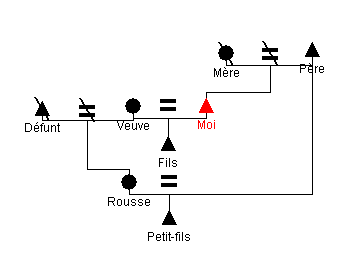
Diagramme réalisé grâce au Kinship Editor de Michael D. Fischer.
ToTeach: Theory and Practice
Mostly a reminder, for myself, to use these two blog entries the next time I teach cultural anthro.
Conseil des Arts du Canada
C’est fait. J’ai répondu aux questions du sondage du Conseil des Arts. Un peu long comme processus, mais j’ai l’impression que ça vaut la peine.
Faut dire que le Conseil est en pleine période de consultation pour son plan stratégique des années 2008 à 2011:
Consultation – plan stratégique – Conseil des Arts du Canada
Pour quiconque s’intéresse de près ou de loin aux domaines des arts au Canada, c’est une occasion rêvée pour faire part de nos idées. Le document (PDF) qui accompagne la consultation est assez détaillé et il révèle une partie intéressante du travail accompli.
Évidemment, tout changement prend du temps, surtout dans une institution aussi lourde que le Conseil des Arts du Canada. Les questions sur lesquelles se concentre le Conseil, dans le processus de consultation, tournent beaucoup autour de l’adaptation du Conseil à de nouvelles réalités (sociales, démographiques, économiques, culturelles…). Le but n’est pas vraiment de remettre en question le Conseil lui-même mais plutôt de s’assurer que son orientation générale (valeurs fondamentales, priorités, budgets) soit compatible avec les changements auxquels le Canada fait face, présentement.
Malgré tout, le questionnaire contient surtout des questions relativement ouvertes. En général, on dirait que le Conseil tente réellement de tâter le pouls des répondants et non de diriger les réponses. Même si le questionnaire semble s’adresser prioritairement à ceux qui ont des contacts fréquents avec le Conseil (p.ex., les artistes et les mécènes), il me semble pertinent pour tous ceux qui accordent de l’importance aux arts de collaborer à la révision du plan stratégique du Conseil des Arts du Canada.
Ça y est, je parle comme un fonctionnaire du Conseil! 😉
There's a Whole World Out There
The effect of finding out that there’s a wealth of information that is openly available:
To me, this was a little like the first human sighting of the Antarctic land mass in 1820: proof that a huge terra incognita existed just over the horizon, awaiting exploration.(Peter Suber, SPARC Open Access Newsletter, 11/2/06
)
This is an important feeling (and an important issue). As the Gershwins had it:
I know how Columbus felt
Finding another world
The first time I recall feeling this way was at the end of the year, in elementary school. We had been using this math textbook with exercises for every chapter. It’s only during the last week of classes that I noticed that answers to the exercises could be found at the end of the book. Finding those answers was a revelation to me and I seek this discovery feeling. It’s one that I get from fiction (books, television shows, etc.). You find the key and everything falls into place.
What’s the connection, here?
Well, maybe I’m going on a limb. But I see a connection between Open Access, textbooks, and discovery. In fact, it runs through what I was trying to present this past week at the Spirit of Inquiry conference.
Sure, we all know about information overload and many of us would like authoritative filters for information. But the real point is about getting awestruck by the amount of work that has already been done. Sure, it’s intimidating when you take a look at the dusty shelves of a good size library. But we can also focus on doing something with all this information. Sure, the Encyclopedia of Life is bigger than any library, as many people keep reminding us, these days. But we can still start from access to published texts, can’t we?
Newton’s “shoulders of giants” and all that. The opposite of the forbidden library in Eco’s The Name of the Rose. Regardless of opposing views about what should be done with information, most people agree that there’s something empowering about anybody getting access to valuable information.
Some academics are “immunized” to the awe-inspiration from seeing the amount of information available. Some of them simply focus on a tiny parcel of knowledge-land they can call their own. Others insist that most information is completely relevant. Yet others think about knowledge in less of an information-processing model.
That’s why I think that making resources openly and publicly available is more important for students than for tenured professors.
Yes, I do care about students.
Professors and Online Ethnography
Fellow anthropologist Michael Wesch (of The Machine Is Us/ing Us fame) posted about a video that the The Chronicle of Higher Education has released about his own digital ethnography projects.
For those who don’t know, The Chronicle is a well-known U.S. publication aimed primarily at university and college professors. It contains news and job announcements irrespective of disciplinary boundaries. A bit like the CAUT/ACPPU Bulletin here in Canada.
The video itself is journalistic in tone and does pay lipservice to the challenges of online research. I like the fact that we get to hear one of Wesch’s students, known as ThePoasm on YouTube. But, overall, the video does little to give voice to the people involved, apart from Wesch himself. The lack of student focus is unsurprising as The Chronicle is mostly concerned with faculty members. But there could have been more talk about the academic, disciplinary, institutional, and pedagogical implications of Wesch’s projects.
Maybe I’m just jealous of Wesch for being able to undertake those projects in the first place. Anyone wants to podcast/vidcast with me? 😉
YULpride
With all the Montreal dynamism, these years, not surprising that there should be posts about the biz-side of Montreal’s “Web 2.0” involvement.
A Frog in the Valley » Blog Archive » 2.0 eh? YUL rules!
It does feel good to be here.
Geeking Out on Syntax
“Judging” grammaticality through software: MiniJudge. (Via Jean Crawford, Starr Linguist)
As a complete outsider to the minimalist program (and to those language sciences which focus on syntax), my perception has often been that judgements of grammaticality relied too heavily on introspection by native speakers. Proponents of these generative theories often talk of “instincts” or “intuitions” for those judgements that native speakers are able to make unconsciously and that non-native speakers have a hard time making. Maybe using software for those judgements would take the generative methodology out of introspective mode.
As a linguistic anthropologist, I just wish linguists and other language scientists could talk to each other.